The Six-Month Dupe Audit: A Complete System for Judging What You Actually Bought
Quick Answer: Judge a dupe on cost per wear, not on purchase price, and run the assessment at six months rather than at first wear. Track four failure modes - fabric recovery, pilling, opacity loss and seam integrity - because those are what actually end a garment’s life. A dupe at one third the price that lasts one quarter as long was more expensive, and this is the most common outcome people never calculate.
This guide gives you the actual audit: what to record, when to check, and how to decide what to buy next.

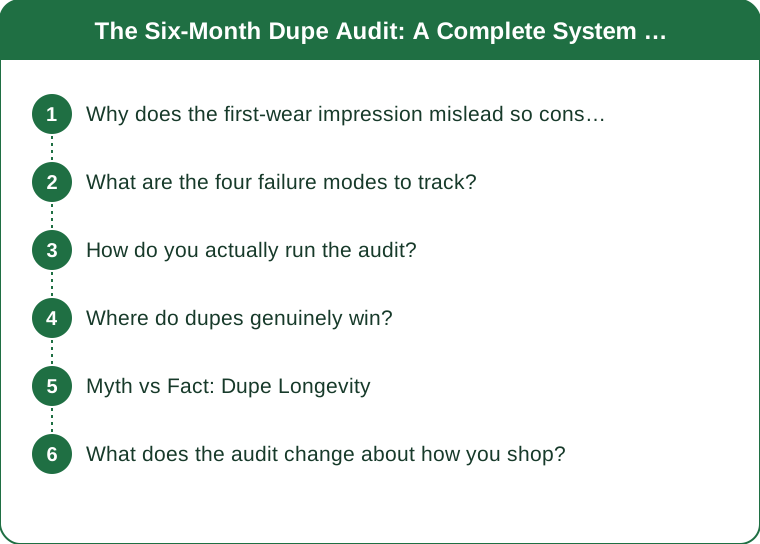
Why does the first-wear impression mislead so consistently?
Because the qualities that sell a garment and the qualities that determine its life are almost unrelated.
What you can assess in the first five minutes:
- Hand feel, which is largely determined by surface finishing
- Color accuracy against the original
- Initial opacity in the fitting room
- Whether the size is right
- The general impression of the seams
What you genuinely cannot assess:
- Fabric recovery over hundreds of stretch cycles, which is the single largest determinant of legging lifespan
- Pilling resistance, which needs weeks of friction to reveal
- Opacity after the fabric has been stretched and washed repeatedly - the failure mode people care about most
- Elastane degradation rate, which shows at month three to six
- Seam and thread durability under repeated load
Why the initial impression is often better on a dupe. Manufacturers optimizing for a first impression at a low price point will invest in the things a customer checks in a shop - surface softness, color, initial hand. A brushed finish that feels luxurious at first touch is also a finish that pills quickly, and both facts follow from the same construction choice.
The consequence. Someone can be genuinely delighted at week one and disappointed at month four, and never connect the two - concluding they got unlucky rather than that the assessment happened too early.
Which is what the six-month audit fixes. It moves the judgment to the point where the answer is knowable, and it records enough that the next purchase is informed rather than hopeful.
What are the four failure modes to track?
These four end almost every legging’s life, and each has a specific test.
1. Fabric recovery. Whether the fabric returns to its original dimensions after being stretched.
- The test: put the garment on and do ten deep squats. Stand up. Does the knee area stay bagged out, or does it snap back?
- Failure looks like: sagging at the knee and seat, a waistband that no longer holds, a garment that feels a size larger by the end of a session
- Cause: elastane degradation, accelerated by heat, chlorine, body oils and fabric softener
- Typical timeline: good fabric holds 12 to 24 months of regular use; poor fabric shows at 3 to 6
2. Pilling. Small balls of tangled fiber, appearing first where fabric rubs fabric.
- The test: inspect the inner thigh and the seat under strong light
- Cause: brushed or spun-yarn surfaces, low knit density
- Typical timeline: poor fabric shows meaningful pilling by 10 to 20 wears; good fabric may never pill noticeably
3. Opacity loss. The point at which the fabric becomes see-through when stretched.
- The test: the squat test in a bright room, ideally with someone honest, or a mirror and a phone camera
- Cause: thinning fabric from repeated stretch, plus color fade
- Timeline: this is the failure people notice most abruptly, often between month 4 and month 8 on thin fabric
4. Seam integrity. Thread failure, seam puckering, or the crotch seam separating.
- The test: stretch each major seam gently and look for gaps between stitches
- Cause: insufficient thread quality, single-row stitching where four-thread overlock is needed, no gusset
- Timeline: poor construction usually shows within 3 months
Log the date each one first appears. That is the entire dataset the audit needs, and it takes seconds per check.
How do you actually run the audit?
Four checkpoints, five minutes each, and a note on your phone.
At purchase, record:
- Price paid, brand, model, size, color
- The date, which is the field everyone forgets and the one the whole calculation depends on
- Initial impressions of the four failure modes, as a baseline
At week 4:
- Wear count so far, which you can estimate
- Any pilling? Any seam issues?
- Recovery check: the ten-squat test
- Early problems at week 4 are a strong predictor of short overall life
At month 3:
- Full four-mode check under good light
- Compare against the original if you own it, side by side, which is far more informative than memory
- Note any change in fit or waistband hold
At month 6 - the decisive checkpoint:
- Full four-mode check
- Estimate total wears. Two a week is roughly 50 wears at six months
- Calculate cost per wear: price divided by wears
- Decide the category: still in rotation, demoted to lounge, or finished
The comparison that answers the question:
- Dupe at 30 dollars, finished at 6 months, 50 wears: 0.60 per wear
- Original at 100 dollars, still going at 24 months, 200 wears: 0.50 per wear
In that example the dupe was more expensive, despite costing a third as much. This is the calculation the entire dupe conversation is missing, and running it once changes how you shop permanently.
A practical shortcut. Keep one note per garment in your phone, four lines long. The effort is genuinely trivial and the payoff compounds - after a year you know which brands hold up on your body, with your washing habits, for your activities, which is information no review can give you.

Where do dupes genuinely win?
In four specific situations, and being clear about them is more useful than a blanket verdict.
1. Low-wear categories. A piece worn ten times a year does not need 200-wear durability. Seasonal colors, occasion pieces, styles you are testing - the durability premium buys nothing here.
2. Fit experimentation. Trying a silhouette you have never worn - a crossover waist, a flare, a new inseam length. Paying full price to discover you dislike a cut is the actual waste. Buy the dupe, learn the answer, buy the good version if you loved it.
3. Fast-changing trends. Anything whose appeal is likely to be shorter than its durability. A garment that outlasts your interest in it is over-engineered for the purpose.
4. High-attrition uses. Gardening, painting, dog walking in mud, travel where loss is likely.
Where dupes reliably lose:
- Daily-wear staples. Black leggings worn four times a week hit the wear counts where durability dominates cost per wear
- High-support items. Sports bras above roughly a D cup depend on band construction and elastane quality, and the failure mode is loss of support rather than appearance
- Anything where opacity failure is unacceptable, since it can happen suddenly and in public
- Technical performance items where the fabric is doing a specific job - genuine compression, real wind resistance, actual thermal regulation
A cautious middle position that works well. Buy the dupe for the shape, the original for the workhorse. Most people’s wardrobes need three or four genuinely durable staples and considerably more low-wear variety, and matching the purchase to the wear pattern beats any general rule about whether dupes are worth it.
Myth vs Fact: Dupe Longevity
Myth: You can tell quality by feel in the shop. Fact: Hand feel is largely determined by surface finishing, and the softest finishes are frequently the ones that pill fastest. Feel predicts almost nothing about lifespan.
Myth: A dupe is always cheaper. Fact: Only on purchase price. On cost per wear, a garment lasting a quarter as long at a third the price is more expensive. The calculation takes thirty seconds and almost nobody does it.
Myth: Same fabric composition means same quality. Fact: 75 percent nylon, 25 percent elastane describes an enormous range of fabrics. Knit density, yarn type, filament count and finishing all vary hugely within an identical composition label - which is why the composition tag is the least useful piece of information on the garment.
Myth: Expensive brands make their own fabric. Fact: Many brands at all price points buy from the same mills. What frequently differs is the specification ordered - weight, density, finish - rather than the source.
Myth: If it survived six months it will last years. Fact: Elastane degradation accelerates. A garment fine at six months can decline noticeably between months eight and twelve, which is why the audit continues past the six-month checkpoint for anything you rely on.
Myth: Washing does not make much difference. Fact: Heat is the primary enemy of elastane. Cold wash, no softener and air drying can roughly double the usable life of any legging at any price point - which means poor care can make an excellent garment perform like a poor one.
What does the audit change about how you shop?
It converts the buying decision from a guess into a pattern-matching exercise.
After one year of records, you will know:
- Which brands hold up on your body, which is not the same as which brands hold up generally. Body shape, activity type and wash habits all interact with fabric
- Your actual wear rate per category, which is almost always different from what you assumed
- Which failure mode ends garments for you. Some people pill everything; others destroy waistbands; others never wear anything out and simply get bored
- The price point where durability stops improving. It is rarely the top of the market
That last point deserves emphasis. Durability and price correlate up to a point and then flatten. Above a certain price you are typically buying design, brand, and retail experience rather than more wear cycles. Your own records identify where that point sits in your wardrobe, and it is usually lower than the marketing implies.
How to use the findings:
- Buy your three or four highest-wear items at the durability sweet spot, whatever your data says that is
- Buy everything low-wear as cheaply as satisfies you
- Stop replacing the same failing item repeatedly - three cheap versions of the same failing legging costs more than one that works, and this is the most common invisible expense in an activewear wardrobe
On the wider point about dupe culture. The question is not whether dupes are ethical or whether they are as good. The question is whether a specific garment at a specific price will serve a specific use for long enough to be worth it - and that is answerable with four notes and a calculator.
One final caution about the audit itself. Do not let the tracking become the hobby. Four lines per garment, four checkpoints, one calculation. If it takes longer than that, it will stop happening, and a system you abandon tells you nothing at all.
TL;DR:
- First-wear impressions are driven by surface finish, which predicts almost nothing about lifespan
- Track four failure modes: fabric recovery, pilling, opacity loss and seam integrity
- Check at week 4, month 3 and month 6, then calculate cost per wear - price divided by wears
- A dupe at a third the price lasting a quarter as long was more expensive, and that is the common case
- Dupes win on low-wear items, fit experiments, trends and high-attrition use; they lose on daily staples and support garments
Four lines per garment, four checkpoints. After a year you will know exactly where your own durability sweet spot sits, which no review can tell you.
See It in Motion
Seen here: High Waist Yoga Leggings with Inner Pocket — shop it on bubblelime.com
Keep Reading
This article is for general informational and styling purposes only. Fit, sizing, and product availability may vary.