The Complete Guide to Knowing When a Dupe Is Actually Worth It
Quick Answer: Dupes work well in categories where the value is in the pattern and the fabric is commodity — basic leggings, sports bras in simple constructions, tees, and shorts. They fail in categories where the value is in proprietary fabric development, complex panelling, or hardware. Judge by fabric composition, weight, and seam construction rather than by appearance, and calculate cost per wear over two years rather than comparing sticker prices.
This is the long version: the categories, the spec sheet, the cost maths, and the specific failure modes that make some dupes a false economy.

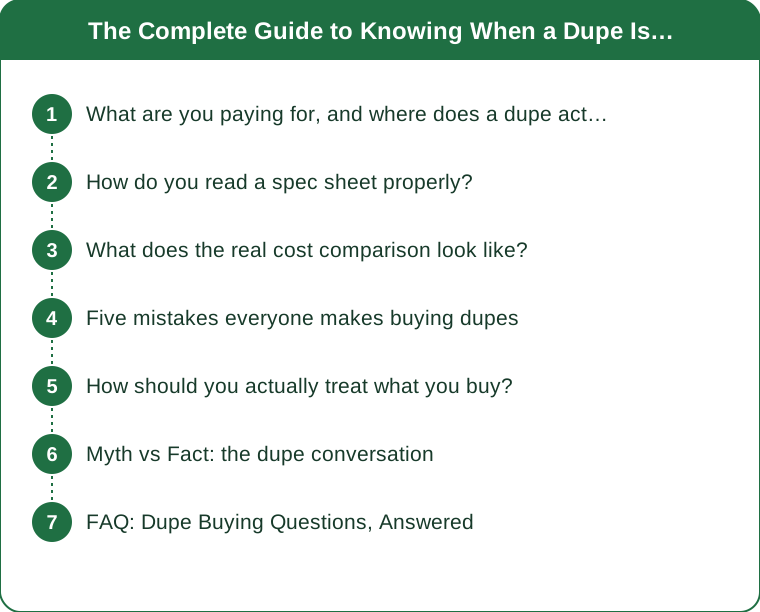
What are you paying for, and where does a dupe actually work?
What are you actually paying for at the premium end?
This is the foundational question, and answering it honestly is what makes the rest of the framework work.
Fabric development is the largest genuine cost. A proprietary knit takes years and substantial money to develop — the specific blend, the knit structure, the finishing treatment, and the mill relationship required to produce it consistently at scale. When a brand has a signature fabric that people describe by name, that is a real technical asset, and it is the hardest single thing to copy. A dupe can match the composition on paper and feel entirely different, because composition is only part of what determines hand feel. Knit density, yarn twist, finishing chemistry, and the mill’s consistency all matter, and none of them appear on a label.
Fit development is the second. A well-fitting legging is the output of many rounds of fit sampling across a range of body types, with pattern adjustments at each round. This is expensive, invisible, and it is why a premium legging often fits well on people it was not specifically designed for — the pattern has been through enough iterations to be forgiving. Cheap patterns are typically graded up and down from a single sample size using simple mathematical rules, which is why they fit one size range well and everything else badly.
Then there are the costs you may not value. Marketing, retail space, ambassador programmes, and margin. These are real costs that contribute nothing to the garment. A meaningful fraction of a premium price is here, and this is the portion a dupe legitimately strips out.
Quality control is the last one, and it is underrated. Consistency between units — that the pair you buy next year matches the pair you bought this year — costs money in inspection and mill management. Dupe brands vary enormously batch to batch, and this is the single most common complaint from people who bought a great dupe and then a terrible one.
So the framework is: you are trying to keep the fabric and fit development while stripping the marketing and retail margin. Sometimes that is possible, and sometimes it is not.
Which categories does a dupe reliably work in?
There is a clear pattern, and it tracks technical complexity almost exactly.
Basic leggings in standard fabrics — dupes work well. A mid-weight nylon-elastane legging with a wide waistband and flatlock seams is a well-understood garment. Dozens of mills produce competent versions of the fabric. The pattern is not exotic. A good dupe here can be genuinely 85-90% of the premium experience at a third of the price, and this is where most of the value in the whole category sits.
Simple sports bras — dupes work, with a size caveat. A light-to-medium support pullover bra is a simple construction. Dupes do this well. High-impact encapsulated bras with underwire, adjustable straps, and multiple panels are a different engineering problem and dupes routinely fail at them — the support simply is not there, and for larger cup sizes this is not a cosmetic issue.
Tees, tanks, and shorts — dupes work very well. Low technical requirements, and the premium versions are frequently the highest-margin items in a brand’s range. This is the easiest win in the category.
Seamless and compression pieces — mixed. Seamless knitting requires specific machinery, and the good dupes come from factories that have it. When it works it works well; when it does not, the fabric is thin and the compression is uneven.
Outerwear and anything with hardware — dupes reliably fail. Zips, water-resistant membranes, taped seams, and technical linings are where cheap manufacturing shows immediately. A zip that fails in month four ruins a jacket in a way a slightly-less-soft legging never ruins a legging.
Anything with a proprietary fabric as the selling point — dupes fail. If the reason people buy the original is a named fabric with a distinctive feel, no dupe reproduces it. You can get a good legging; you cannot get that legging.
How do you read a spec sheet properly?
Almost everything you need is in four numbers and one photo, and most people look at none of them.
Fabric weight, in gsm. The most informative single number. Below 220gsm you are in sheer territory for most colours and body positions. 240-280gsm is the practical sweet spot for an everyday legging — opaque, comfortable, not hot. Above 300gsm is genuinely warm and better suited to autumn and winter wear. If a listing does not state weight, that absence is itself informative: brands that hit a good weight publish it.
Elastane percentage. 12-25% for activewear. Below 10% you get insufficient recovery, which means bagging at the knee and seat within a few wears. Above 30% and the fabric tends to feel rubbery and holds odour more.
The main fibre. Nylon versus polyester matters more than most buyers realise. Nylon is softer, more abrasion resistant, and more expensive. Polyester is cheaper, holds colour better, dries faster, and holds odour more. A nylon-dominant blend at a dupe price is a genuine signal of a serious product.
Seam construction. Look for flatlock seams — flat, wide, no ridge. Overlock seams have a visible ridge and are the standard cheap construction; they chafe and they are the first thing to fail. Check the inner thigh specifically, because that is where the abrasion is and where garments split.
The photo to hunt for: a squat or bend test. Brands confident in their opacity show one. Brands that are not, show only standing shots from the front. The absence of a bend photo across an entire product page is a reasonable proxy for thin fabric.
And read the reviews for the word ‘batch’ or ‘second pair’. Consistency complaints are the most reliable early signal of a dupe brand that has scaled past its quality control.
What does the real cost comparison look like?
Sticker price is the wrong comparison, and the right one changes conclusions more often than people expect.
Work in cost per wear over a defined period. Take two years, which is roughly the useful life of a well-treated legging in regular rotation.
A premium legging at $98 worn twice a week for two years is about 208 wears, giving roughly 47 cents per wear — assuming it lasts, which for a well-made legging with proper care it generally does.
A dupe at $28 worn at the same rate: if it lasts the full two years, that is 13 cents per wear, and it is an obvious win. If it lasts eight months, you buy three across the period, giving 40 cents per wear — still cheaper, but the gap has collapsed, and you have spent three shopping cycles and dealt with two disappointments.
If it lasts four months, you are at six pairs and 81 cents per wear, which is nearly double the premium option, plus the environmental cost of six garments instead of one.
The variable that decides everything is longevity, and longevity is mostly determined by fabric weight, elastane quality, and how you wash it. Which means the highest-value action in the whole framework is not choosing the right brand — it is washing cold, inside out, and never using the dryer. Heat is what destroys elastane, and a dupe treated well often outlives a premium pair treated badly.
One more factor rarely counted: the cost of the pairs you do not wear. A dupe that arrives and does not fit properly is not 13 cents per wear, it is $28 for nothing. Return friction on cheap direct-from-overseas brands is high enough that most people simply absorb the loss, and that hidden failure rate is a real part of the category’s true cost.

Five mistakes everyone makes buying dupes
1. Buying based on appearance rather than specification. The visual match is the easiest thing to copy and the least predictive of satisfaction. Two leggings that look identical in photographs can differ by 80gsm in weight, which is the difference between opaque and sheer. Judge by the numbers, and treat the photos as decoration.
2. Buying multiple pairs before testing one. The single most common expensive error. The three-pack discount is designed precisely to exploit this. Buy one, wear it ten times, wash it three times, and then decide. The pair that feels wonderful on day one and pills at the inner thigh by wash four is a very common pattern and only ten wears reveal it.
3. Ignoring the return policy. A cheap garment with a difficult return process is not cheap; it is a lottery ticket. Brands shipping direct from overseas with 30-day windows and return shipping at your cost effectively have no returns. Factor that into the price you are willing to pay.
4. Applying dupe logic to the wrong category. The framework above exists because category matters more than brand. A dupe tee is almost always a good decision. A dupe high-impact bra for a larger cup size is almost never one, and the consequence is not aesthetic — inadequate support during running is a genuine comfort and tissue issue.
5. Assuming the price gap reflects the quality gap linearly. It does not, in either direction. A $28 dupe is frequently 85% of a $98 garment, which is excellent value. A $58 mid-tier piece is frequently 95%, which may be the actual best purchase and is the option most dupe discussions skip entirely. The mid-tier is the most consistently overlooked answer in this whole conversation.
How should you actually treat what you buy?
This is the section that changes outcomes most, and it applies identically at every price point.
Wash cold, always. Elastane degrades with heat. Every hot wash measurably shortens the life of the fabric’s recovery. Cold water with a technical detergent cleans activewear perfectly well, because the soils involved are body oils and sweat rather than ground-in dirt.
Never use the dryer. This is the single largest determinant of activewear lifespan, and it is not close. A dryer cycle does more damage to elastane than a month of wear. Air drying takes a few hours and roughly doubles useful life. If you take one thing from this entire guide, this is it.
Wash inside out. The inside is what touches your skin and holds the oils; the outside is what you want to keep looking good. Inside out cleans better and abrades the visible surface less.
Skip the fabric softener. It coats technical fibres, destroys wicking, and traps odour. It is actively counterproductive on every activewear fabric.
Do not leave them balled up in a bag. Bacterial growth in damp fabric is what causes the permanent smell that never washes out. Getting them out of the bag within a few hours matters more than washing them immediately.
Rotate. Elastane recovers its shape with rest. Wearing the same pair four days running produces visible bagging that would not occur with rotation. Three pairs in rotation last more than three times as long as one pair worn constantly.
And be honest about pilling. Pilling at the inner thigh is friction damage and it is not preventable by washing technique — it is determined by fabric quality and by whether your thighs touch, which is not a fault in either the garment or you. If a brand pills in four wears, that brand is answered, and no care routine fixes it.
Myth vs Fact: the dupe conversation
Myth: Dupes and originals come from the same factory, so they are identical. Fact: Sometimes the factory genuinely overlaps, and it still does not follow. Factories run to the specification they are given — fabric supplier, weight, seam type, inspection standard. The same building produces very different garments at different price points. ‘Same factory’ is the most repeated and least meaningful claim in the category.
Myth: If it feels good in the fitting room, it is good. Fact: New fabric feels good almost universally. Finishing treatments make cheap fabric feel soft, and those treatments wash out in three to five cycles. The judgement point is wash four, not day one.
Myth: Expensive means it will last longer. Fact: Correlated, not causal. Plenty of premium price is marketing, and plenty of premium garments fail at the inner thigh like anything else. Care practice predicts lifespan better than price does.
Myth: Buying dupes is worse for the environment. Fact: It depends entirely on longevity. One garment worn 200 times beats four worn 50 times each on essentially every impact measure. A dupe that lasts is fine; a cycle of replacements is not, regardless of what is being replaced.
Myth: You should always buy the cheapest thing that works. Fact: The cheapest thing that works over two years is often not the cheapest thing on the shelf, and the mid-tier is frequently the answer. Optimising for sticker price is how people end up with six pairs of leggings and nothing they like wearing.
FAQ: Dupe Buying Questions, Answered
What is the single best test before committing to a brand?
Buy one pair, wear it ten times, and wash it four. Almost every failure mode — pilling, sheerness after stretching, waistband roll, seam puckering, colour loss — appears within that window. Nothing about day one is predictive.
How do I check opacity without a fitting room?
Squat in front of a mirror in bright light, in the exact colour you bought. Light and mid greys are the worst offenders and black is the most forgiving, so testing a black pair tells you almost nothing about the grey one from the same brand.
Is it worth paying more for a specific feature?
Yes for two things: a genuinely secure pocket, and a waistband that does not roll. Those two are the most common reasons a legging gets abandoned while still physically fine, and both are hard to assess from photos. Everything else — colour, minor fabric differences, branding — matters less over two years than either of them.
TL;DR:
- You are trying to keep the fabric and fit development while stripping marketing and retail margin — sometimes possible, sometimes not.
- Dupes work well for basic leggings, tees, shorts, and simple bras; they reliably fail for outerwear, hardware, high-impact bras, and proprietary fabrics.
- Judge by gsm (240-280 for everyday), elastane (12-25%), main fibre (nylon is the quality signal), and flatlock seams at the inner thigh.
- Calculate cost per wear over two years — a dupe that lasts four months costs more than a premium pair that lasts two years.
- Buy one pair and test to wash four before committing; never buy the three-pack first.
- Wash cold, inside out, no dryer, no softener, and rotate three pairs — care predicts lifespan better than price does.
- The mid-tier is the most consistently overlooked answer in the entire conversation.
The framework is not about finding the cheapest garment. It is about identifying which categories genuinely commoditise and which do not, and then treating whatever you buy well enough that the question of price stops mattering.
See It in Motion
Seen here: Racerback Tank Top - White — shop similar styles on bubblelime.com
Keep Reading
This article is for general informational and styling purposes only. Fit, sizing, and product availability may vary.