The Complete Guide to What a Dupe Cannot Copy
Quick Answer: Dupes copy what a photograph shows: silhouette, colour, waistband shape, and visible detailing. What they cannot copy is anything that requires either proprietary inputs or expensive process time - the specific yarn and knit structure, fabric recovery over hundreds of wears, pattern grading across the size range, and post-purchase support. That is why a dupe can look identical on day one and behave differently by wash thirty. Judge a dupe on recovery, grading, and returns policy, not on the photograph.
A good dupe is a genuinely impressive piece of reverse engineering. The photograph, the shape, the waistband height, the seam lines - all of it can be matched closely and cheaply.
What follows is the honest list of what remains, and how to check each one before you spend anything.

What can a dupe copy almost perfectly?
The silhouette and the proportions. Rise height, inseam length, waistband width, the placement of seams - all of this is measurable from a garment or estimable from good photographs, and it is straightforward to reproduce. This is why dupes photograph so convincingly.
The colour. Dye matching is a mature, inexpensive process. A dupe in the same colour family is often indistinguishable in a photograph and frequently indistinguishable in person on day one.
Visible construction details. Contrast stitching, flatlock seams, a crossover waistband, a hidden pocket. If it can be seen, it can be copied, and the tooling to do so is not expensive.
The general fabric feel at first touch. Buttery handfeel comes largely from fibre blend and finishing treatments, and a similar feel can be produced with a similar blend at much lower cost. The critical caveat is that finishing treatments wash out and fibre structure does not.
The marketing language. Squat-proof, four-way stretch, second-skin - none of these are regulated terms with defined tests behind them, so they can be applied to anything.
The photography itself is copied too. Listing images are frequently shot in the same style, on similar models, in similar light, which removes the last visual cue a buyer might have used to tell the two apart before ordering.
Which is a real achievement, not a criticism. A dupe that nails silhouette, colour, and detailing for a third of the price is a legitimately good purchase for plenty of uses - a second pair for laundry rotation, a colour you are unsure about, or a style you want to test before committing. The question is only which of the remaining factors matter to you, and that depends entirely on how hard and how often the garment will be worn.
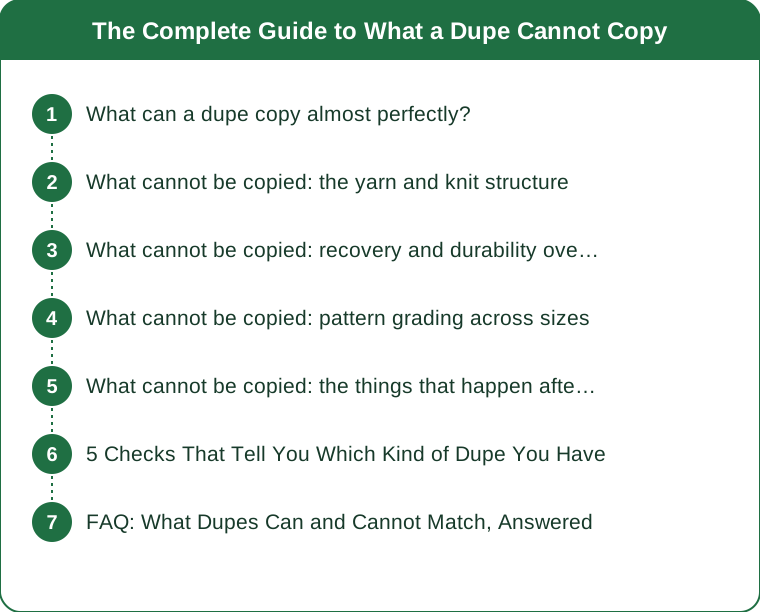
What cannot be copied: the yarn and knit structure
Fabric is a specification, not an appearance. A knit is defined by fibre type and blend ratio, yarn thickness, twist, knit structure, stitch density, and the finishing applied. Two fabrics can look and feel similar on day one while differing on every one of these.
Elastane content and quality determine recovery. The proportion of elastane and, importantly, its grade and how it is incorporated determine whether the fabric returns to shape after being stretched thousands of times. This is the single largest divide between a garment that holds its shape for two years and one that bags at the knee within months.
Denser knits cost more time on the machine. A higher stitch density means slower production and more yarn per garment. It also means better opacity, better abrasion resistance, and a more stable fabric. Reducing density is one of the most direct ways to hit a lower price.
Finishing treatments are often the illusion. Softeners and hand-feel treatments can make an ordinary fabric feel premium in a shop and wash out over the first several cycles. This is precisely why a dupe can feel identical in week one and noticeably different in month three.
Some fabrics are genuinely proprietary. Where a brand has developed a specific yarn with a mill under an exclusivity arrangement, it cannot simply be bought by a competitor. A similar fabric can be sourced; the same one usually cannot.
How to check it before buying: look for stated fibre composition and elastane percentage on the listing, weight in grams per square metre if given, and reviews that mention performance after multiple washes rather than on arrival.
What cannot be copied: recovery and durability over time
Recovery is the property that matters most and is hardest to fake. Stretch is easy - almost any knit stretches. Returning to exact original dimensions after repeated stretching is a function of fibre quality and construction, and it degrades with heat, detergent, and time.
The failure shows up in predictable places. Bagging at the knee and the seat, waistbands that stop gripping, and inner thighs that pill or thin are all recovery and abrasion failures rather than manufacturing defects.
Thirty washes is roughly the point of divergence. Many people report that dupes and originals feel comparable for the first several wears and separate somewhere between twenty and forty washes, which is why early reviews are systematically over-optimistic.
Seam construction determines what happens under load. Flatlock and coverstitch seams distribute stress; a simple overlock seam in a high-stress area is where a squat produces a failure. This is visible if you turn the garment inside out and look.
Opacity loss is a related failure. As a fabric thins with abrasion and loses recovery, it becomes more transparent under stretch. A garment that passes the squat test new can fail it a year later.
Colour behaviour diverges too. Cheaper dye fixing shows up as fading and as dye transfer onto pale shoes or a sofa, both of which appear well after the return window has closed.
The cost per wear is the honest comparison. A garment at a third of the price that lasts a quarter as long is more expensive per wear, not less - and a garment at a third of the price that lasts half as long is still cheaper. The maths only works once you know the second number.
How to check it before buying: search reviews specifically for the words after washing, months, and pilling. One review describing month six is worth fifty describing the delivery.

What cannot be copied: pattern grading across sizes
Grading is how a pattern changes across a size range, and it is expensive to do well. Bodies do not scale uniformly - the difference between a size 8 and a size 18 is not a proportional enlargement in every dimension - so good grading requires separate fitting work at multiple sizes.
Cheap grading scales one pattern mathematically. This produces a garment that fits well at the size it was fitted on and progressively worse at the extremes of the range. It is the most common reason a dupe fits perfectly for one person and terribly for another with the same measurements elsewhere.
The symptoms are specific. Waistbands that gape at the back, rises that are proportionally too short in larger sizes, inseams that do not lengthen appropriately, and crotch seams that sit wrong are all grading problems rather than sizing errors.
Fit models differ between brands. Even between originals, sizing varies because each brand fits on a different body. A dupe fitted on yet another body will not match the original’s fit even at nominally the same size.
This is why dupe sizing reviews are contradictory. When half the reviews say size up and half say true to size, that is usually a grading inconsistency across the range rather than reviewers being unreliable.
How to check it before buying: look for a garment measurement chart rather than only a body measurement chart, and read reviews from people at your size specifically rather than the average of all reviews.
What cannot be copied: the things that happen after you buy
Returns policies are a real cost that dupes usually cut. A generous, free, no-questions returns window is expensive to operate, and it is one of the first things to disappear at a lower price. Read the policy before buying, not after.
Warranty and quality guarantees are effectively absent. Some established brands will replace a garment that fails prematurely. A marketplace seller usually cannot and will not, which changes the maths of a failure considerably.
Restocks and colour continuity are not guaranteed. If you find a dupe that fits perfectly, there is often no way to buy it again in six months - the listing changes, the supplier changes, or the specification changes without notice under the same product name.
Consistency between units varies. Two orders of the same dupe listing can come from different production runs with different fabric. This is much rarer with an established brand, which has a specification to hold suppliers to.
Customer service is a genuine differentiator. Being able to reach someone about a fault matters most exactly when something goes wrong, which is the scenario a low price is implicitly discounting.
How to check it before buying: read the returns window and who pays for return shipping, check whether the seller has been listing the same product consistently, and buy through a platform with buyer protection if you are unsure.
5 Checks That Tell You Which Kind of Dupe You Have
Check 1: The stated composition. A listing that gives fibre percentages and a fabric weight is a listing from someone who knows their specification. No composition at all is a meaningful signal.
Check 2: The stretch-and-release test. Stretch a section of fabric firmly and release. Immediate full return is good. A visible lag, or a section that stays slightly distorted, predicts knee bagging.
Check 3: Inside-out seams. Turn it inside out and look at the crotch, the inner thigh, and the waistband join. Flat, even, multi-thread seams in those three places are the ones that survive squats.
Check 4: Garment measurements, not body measurements. A brand that publishes actual flat measurements per size is a brand that has graded properly. One that only gives body ranges is asking you to guess.
Check 5: The returns policy, read fully. Window length, who pays return shipping, and whether worn items can be returned. This single check has more effect on the real cost of a bad dupe than any fabric assessment.
The one almost nobody does is the fifth. People inspect the fabric carefully and then discover the return window is fourteen days from dispatch, which is roughly when the parcel arrives.
FAQ: What Dupes Can and Cannot Match, Answered
Are activewear dupes as good as the original?
Often on day one, frequently not by month six. They match silhouette, colour, and visible detailing closely, and they typically differ in fabric recovery, knit density, grading quality, and after-sales support.
How long before a dupe shows its quality?
Commonly somewhere between twenty and forty washes. That is why launch reviews are systematically optimistic and why the useful reviews mention months rather than delivery.
Why does the same dupe fit some people perfectly and others badly?
Usually pattern grading. A cheaply graded pattern is fitted at one size and scaled mathematically, so it fits well near that size and progressively worse toward the ends of the range.
What is the single most useful thing to check before buying?
The returns policy, in full - window length and who pays return shipping. It determines what a wrong purchase actually costs you, which matters more than any fabric detail you can assess from a photograph.
Can a dupe use the same fabric as the original?
Sometimes a similar one, rarely the same one. Where a brand has an exclusivity arrangement with a mill for a specific yarn, that fabric is not available to buy - which is why same factory claims are usually about a facility rather than a specification.
TL;DR:
- Dupes copy what photographs show - silhouette, colour, visible detailing, and first-touch handfeel - and do it well.
- They cannot copy proprietary yarn and knit specifications, which is why finishing treatments wash out and recovery diverges by around thirty washes.
- Cheap pattern grading scales one fitted size mathematically, which is why the same dupe fits some people perfectly and others badly.
- Returns policies, warranties, restock consistency, and unit-to-unit consistency are cut at low prices and matter most when something goes wrong.
- Five checks before buying: stated composition, stretch-and-release recovery, inside-out seams, published garment measurements, and the full returns policy.
A dupe is a good purchase when you know which of these you are trading away. It is a bad one when you assumed you were not trading anything.
Keep Reading
This article is for general informational and styling purposes only. Fit, sizing, and product availability may vary.