The Complete Guide to Judging a Sports Bra Dupe
Quick Answer: A sports bra dupe succeeds or fails on four things a photo cannot show: underband tension and width, strap construction and anchoring, cup or panel structure, and fabric recovery. The underband does 70 to 80 percent of the support work in a well-designed bra, so a dupe that copies the strap styling and skimps on the band has copied the wrong part. Test it with a jump test, a strap-lift test, and a stretch-recovery test in the first ten minutes, before removing tags. Get those right and price is close to irrelevant.
Most activewear dupes are a fabric question. Leggings can be judged by squat-testing them, feeling the hand, and checking the seams - and the worst outcome of a bad pair is that they are uncomfortable.
Sports bras are different. They are the only piece of activewear that has an actual mechanical job to do, and a failure is not merely disappointing - it is discomfort during every session, and over time it can mean genuine strain.
They are also the item where the visible design and the functional design overlap least. The parts you photograph are not the parts that work.

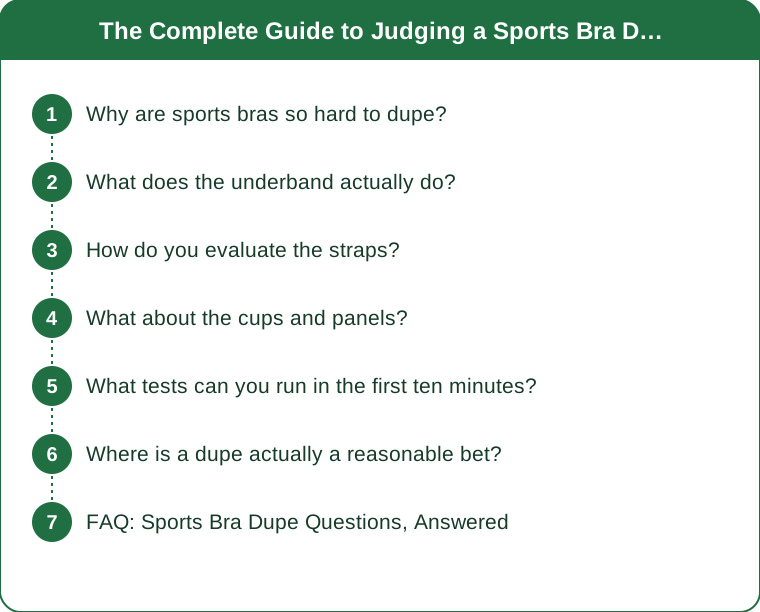
Why are sports bras so hard to dupe?
Because support is engineering, and engineering is expensive to copy while styling is nearly free.
A leggings dupe needs to match fabric, cut, and construction quality. Those are hard but they are all essentially the same category of problem - materials and sewing.
A sports bra has to actively control movement. Breast tissue has no muscle in it and is supported by skin and connective tissue, so during running or jumping it moves in a three-dimensional pattern - vertical, lateral and front-to-back. A bra’s job is to reduce that movement across all three axes, and doing it requires structure that costs money and design work.
What that structure actually involves:
- A firm, wide underband with correctly specified elastic tension
- Straps anchored so that load goes into the band rather than into the shoulder
- Cup or panel shaping that encapsulates or compresses effectively for the size range
- Fabric with high recovery so all of the above still works at wash thirty
- Fit testing across a real size range rather than on one model
None of that is visible in a product photo. What is visible is strapping, colour, seam lines and logo placement - which is why a dupe can look like an eighty-dollar bra for eighteen and perform like a crop top.
And the incentive is bad. The manufacturer knows most buying decisions are made from a photo. Investing in an underband nobody can see, versus investing in a strap pattern everybody can see, is not a difficult commercial decision.
What does the underband actually do?
The large majority of the support work - commonly cited as 70 to 80 percent - and it is the first thing cut from a cheap copy.
This is the single most important thing to understand, because it reframes what you are looking for. The straps feel like the support system because you can feel them on your shoulders. They are not. A well-designed bra transfers most load into the band around your ribcage, which is anchored against bone and can carry it without discomfort.
What separates a good band from a bad one:
Width. A wider band spreads pressure over more area and resists riding up. Narrow bands concentrate pressure into a line, which is both less effective and what causes that specific band-digging discomfort.
Elastic quality and tension. The band needs to be firm without being tight - and firm-yet-comfortable is precisely the expensive part. Cheap elastic either lacks tension from day one or loses it within weeks.
Construction. A band with a bonded or well-finished edge holds shape. A band that is simply a folded-over hem of the main body fabric has no independent structure and will roll.
Whether it is a separate component at all. This is the fastest tell. Pick up the bra and look at the bottom edge. Is the band a distinct piece of engineered elastic, or is it the same fabric as the body with a hem? The second one is a crop top with straps.
The test: put it on and lift your arms overhead. If the band rides up more than a couple of centimetres, it is too loose or too weak, and no amount of strap adjustment will fix it. That is a return.
How do you evaluate the straps?
Straps matter less than the band and more than nothing, and there are three things to check.
Where they anchor. Follow each strap with your finger to where it meets the body of the bra. A strap that anchors into the band, or into a structural panel connected to the band, is carrying load properly. A strap sewn only to the top edge of the cup is transferring load directly into your shoulder, which is where strap-related neck and shoulder discomfort comes from.
Width and padding. Wider straps distribute pressure. For anything above light support, narrow spaghetti-style straps are decorative rather than functional, regardless of how the bra is marketed. Racerback and cross-back designs generally outperform straight straps because they resist sliding outward and pull load toward the centre.
Adjustability. Adjustable straps are a strong quality signal for two reasons: they cost more to make, and they let the bra fit torso lengths that a fixed strap cannot. Most cheap dupes have fixed straps, which is why they fit some people well and others badly with no middle ground.
The strap-lift test, and it takes five seconds: with the bra on, slide a finger under a strap and lift. If the cup lifts noticeably with the strap, the straps are carrying the load and the band is not doing its job. In a well-constructed bra, lifting the strap does very little because the support is coming from below.
This single test tells you more about a sports bra than every product photo you will ever look at.

What about the cups and panels?
Two design philosophies, and duping them fails in different ways.
Compression bras hold tissue against the chest wall. Simple to make, generally fine for smaller sizes and lower-impact activity, and they scale badly - compression alone is not sufficient for larger cup sizes or high-impact work, no matter how tight it is.
Encapsulation bras support each breast separately with shaped cups. Far better for larger sizes and high impact, and far harder and more expensive to make well. Most high-support bras use both together.
Where dupes fail:
Removable pads instead of structure. A pad is not support. Many dupes include pads that look like shaping and provide none, and the pads themselves are usually the first thing to deform in the wash - bunching, curling at the edges, never lying flat again.
Seams in the wrong places. Well-designed cup seams follow the shape of the tissue and add structure. Decorative seams that mimic the look without the shaping add nothing and can create pressure points.
No size-specific engineering. This is the big one. A properly designed bra changes its construction across the size range - more structure, wider bands, different strap configurations for larger sizes. A dupe usually applies one construction to every size, which is why dupes so often work acceptably in smaller sizes and fail badly in larger ones. If reviews are polarised by size, this is why.
Underwires, where present, are genuinely difficult to copy - correct wire shape and gauge for each size is expensive. A cheap wire in the wrong shape is worse than no wire at all.
What tests can you run in the first ten minutes?
Do all of these before removing tags, in front of a mirror, in good light.
1. The jump test. Put it on and jump ten times, then jog on the spot for thirty seconds. This is non-negotiable and it is the whole point of the garment. Standing still tells you nothing about a sports bra. If there is noticeable bounce, or if it feels like the bra is moving separately from you, it fails.
2. The strap-lift test. As above. Lift a strap and see whether the cup moves with it. Significant movement means the straps are doing the band’s job.
3. The arms-overhead test. Reach up. The band should stay put. Riding up means the band is too loose or too weak.
4. The two-finger band test. You should be able to slide two fingers under the band with mild resistance - not easily, and not with a struggle. Too loose is the far more common failure.
5. The stretch-recovery test. Pull a section of the band firmly and let go. It should snap back immediately and completely. Slow return, or any residual slack, means poor elastic and predicts failure within weeks.
6. The seam check. Turn it inside out. Look for flat, covered seams in areas that touch skin - particularly under the arm and along the band edge. A raised seam under the arm will chafe on any session over twenty minutes.
7. The sweat-and-hour test, which you can only do after committing. Wear it for a full session. Chafing, band migration, and strap digging all appear at around the forty-minute mark, not in the first five.
Any single failure among tests 1, 2, 3 and 5 is a return, not something to work around.
Where is a dupe actually a reasonable bet?
Not everywhere, and being specific about this saves money in both directions.
Where dupes are genuinely fine:
- Low-impact activity - yoga, pilates, walking, lounging. The support requirement is modest and a decent compression bra meets it.
- Smaller cup sizes, where compression alone is more likely to be adequate.
- Layering pieces worn under something else where support is secondary.
- Trying a new style before committing to an expensive version - a genuinely sensible use of a cheap copy.
Where dupes are a poor bet:
- High-impact activity - running, HIIT, jumping. This is where engineering matters most and where cutting cost shows up fastest.
- Larger cup sizes, where size-specific construction is essential and almost never present.
- Anyone who has had breast pain or discomfort during exercise. If support is a known problem for you, this is not the category to economise in.
- Long sessions. Cheap bras fail at the one-hour mark - chafing, band migration, strap digging - even when they perform acceptably for twenty minutes.
And the durability arithmetic is worth doing. A well-made sports bra retains support for roughly a year of regular use with proper care. A cheap one often loses meaningful support within two to three months. Three cheap bras a year at $20 is $60 for consistently declining support, versus $60 once for a year of consistent support. The dupe is only cheaper if it lasts, and in this category it frequently does not.
Care extends any of them: hand wash or a delicates bag, cold water, never a tumble dryer, and never wring them out. Heat destroys elastic recovery faster than anything else, and elastic recovery is the entire product.
FAQ: Sports Bra Dupe Questions, Answered
How can I tell support level from a product listing?
Look for the band description first, not the impact rating - impact ratings are unregulated marketing terms and mean whatever the brand wants. Listings that specify band width, adjustable straps, and encapsulation or moulded cups are describing actual construction. Listings that only describe fabric feel and colour are telling you what they have to sell, which is styling.
Are expensive sports bras actually worth it?
More consistently than in any other activewear category, yes. The price difference buys engineering - band construction, size-specific patterns, strap anchoring, fit testing across a real range - rather than just fabric. That said, expensive does not guarantee it either: run the same tests regardless of what you paid, because plenty of premium bras are styled well and built adequately.
How do I know when to replace a sports bra?
When the band no longer passes the stretch-recovery test, when it rides up during a session it used to handle, or when you find yourself tightening straps to compensate - that last one is the clearest sign, because it means you are asking the straps to do the band’s failed job. With regular use, expect roughly a year. Rotating between two or three bras extends all of them, since elastic recovers better with rest days.
General information about garment construction, not medical advice. Persistent pain or discomfort during exercise is worth discussing with a healthcare professional rather than solving by trying another bra.
TL;DR:
- The underband does 70 to 80 percent of the work, and it is the first thing a dupe cuts. Check whether it is a real engineered band or a hemmed edge.
- The strap-lift test is the fastest diagnostic there is - if the cup lifts with the strap, the band has failed.
- Jump before you buy. A sports bra assessed standing still has not been assessed.
- Stretch-recovery: the band must snap back instantly and completely. Slow return predicts failure in weeks.
- Dupes are fine for low impact and smaller sizes, and a poor bet for high impact and larger sizes, where size-specific construction matters most.
Everything you can see in a sports bra photo is styling. Everything that determines whether it works is under your ribcage, and it takes ten minutes to check.
See It in Motion
Seen here: High Waist Embossed Yoga Leggings with Side Pockets — shop it on bubblelime.com
Keep Reading
This article is for general informational and styling purposes only. Fit, sizing, and product availability may vary.