The Real Cost of Buying the Wrong Activewear Dupe Twice (And How to Actually Stop)
Quick Answer: Buying a disappointing $25 dupe, then a second $30 dupe hoping for better results, often adds up to more than the $70-90 original would have cost — while leaving you with two mediocre pairs instead of one good one. Breaking the cycle means treating the first dupe purchase as real data, not bad luck.
The math rarely gets done in the moment, but it’s worth doing: two disappointing dupe purchases can genuinely cost more than the original garment you were trying to avoid paying full price for — and you end up with worse results either way.

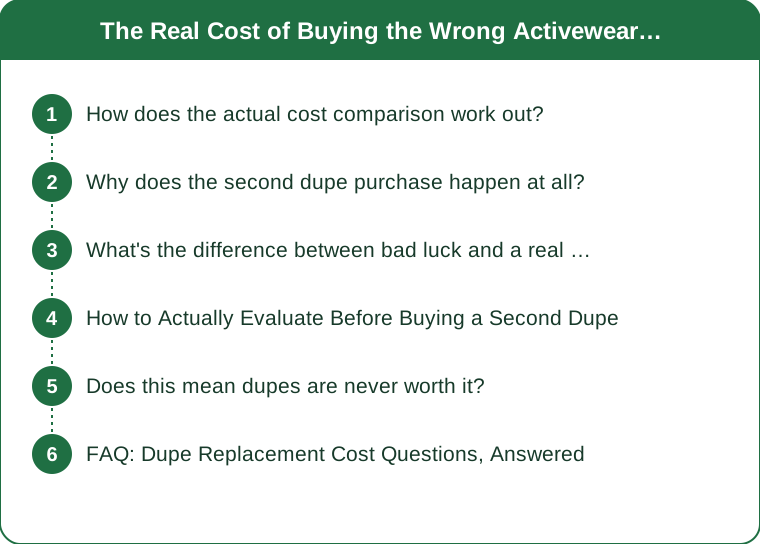
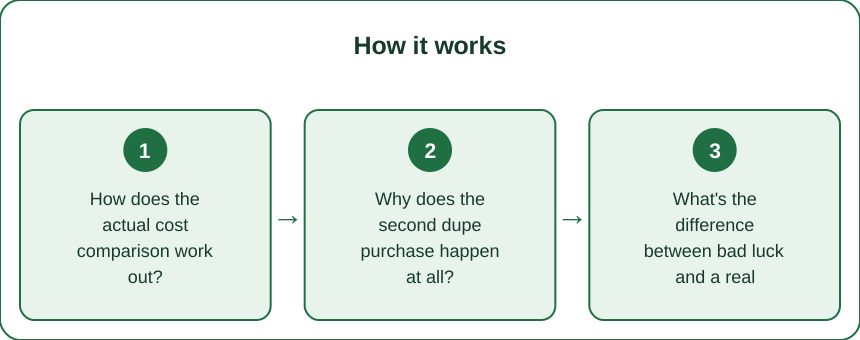
How does the actual cost comparison work out?
A first dupe at $25 that pills within a month, followed by a second attempt at $30 hoping for better luck, totals $55 — already approaching half of what many originals cost, while producing two mediocre garments instead of one durable one.
Add a third attempt, which happens more often than people expect once the first two disappoint, and the total frequently exceeds what the original would have cost outright.
Why does the second dupe purchase happen at all?
Sunk cost thinking plays a role — after one disappointing dupe, there’s a pull to try again rather than admit the strategy didn’t work, especially since the second dupe is often marketed as solving exactly the issue the first one had.
There’s also a genuine belief that the first dupe was just bad luck rather than a signal about that price tier’s actual quality ceiling — which is sometimes true, but often isn’t.
What’s the difference between bad luck and a real signal?
Bad luck looks like an isolated defect — a single seam failure, an unusual sizing error from one specific listing. A real signal looks like the failure mode matching known weak points at that price tier (pilling within weeks, seams failing under normal stretch) — something the fabric-lab research on cheap synthetic blends consistently flags as expected, not exceptional, behavior.
If the failure matches a documented common weak point rather than a one-off defect, a second dupe at a similar price tier is likely to fail the same way.

How to Actually Evaluate Before Buying a Second Dupe
Identify the specific failure mode from the first dupe — pilling, seam separation, fabric thinning — and check whether that’s a documented issue at that price tier (fabric weight is often the tell) before assuming the next dupe will be different.
Compare against one tier up, not the same price point — if $25 failed, evaluate whether $45-55 dupes use noticeably heavier fabric weight or better-reviewed seam construction, rather than repeating the same tier hoping for a different outcome.
Set a two-strike rule: after two disappointing purchases at the same price tier, the data says something about that tier generally, not about bad luck specifically — it’s a signal to either go up a tier or buy the original.
Does this mean dupes are never worth it?
No — plenty of dupes hold up well, especially at a moderate mid-tier price point rather than the cheapest option available. The point isn’t to avoid dupes; it’s to treat a first disappointing purchase as real information about that specific price tier rather than an isolated unlucky draw.
The dupe math nobody does is comparing total spend across attempts, not just the sticker price of a single purchase in isolation.
FAQ: Dupe Replacement Cost Questions, Answered
How do I know if a dupe failure was bad luck or an actual quality signal?
Check if the failure (pilling, seam issues) matches known weak points for that price tier and fabric weight — a matching pattern is a signal, an isolated defect is more likely bad luck.
Is it ever worth trying a third dupe at the same price point?
Generally not — two failures at the same tier is a reasonably strong signal to move up a price tier or buy the original rather than trying a third time at the same level.
Does buying the original always work out cheaper in the long run?
Not always, but once total dupe spend across multiple attempts approaches the original’s price, the durability and time saved from buying it once starts to outweigh the upfront savings.
TL;DR:
- Two disappointing dupe purchases can cost more than the original while producing worse results
- Sunk cost thinking, not evidence, often drives the second purchase
- A failure matching a known weak point at that price tier is a signal, not bad luck
- A two-strike rule — move up a tier or buy the original — breaks the repeat-purchase cycle
The real dupe math isn’t the sticker price of one purchase — it’s the total spend across every attempt it took to get it right.
Keep Reading
This article is for general informational and styling purposes only. Fit, sizing, and product availability may vary.