The Complete Guide to Testing an Activewear Dupe in the First Week
Quick Answer: The mismatch that costs people money is that dupes usually fail after the return window closes - pilling, sagging, and seam failure show up around weeks five to eight, while returns expire at 30 days. The fix is a deliberate seven-day protocol that accelerates the failure modes: a stretch recovery test, a squat opacity test, a full wash cycle, a long wear test, and a seam inspection. Almost everything that will go wrong at week eight is detectable in week one if you know what to look for.
The leggings arrive, they feel great in the bedroom mirror, and you keep the tags on for two days out of vague caution before wearing them. That is not a test. It is a delay.

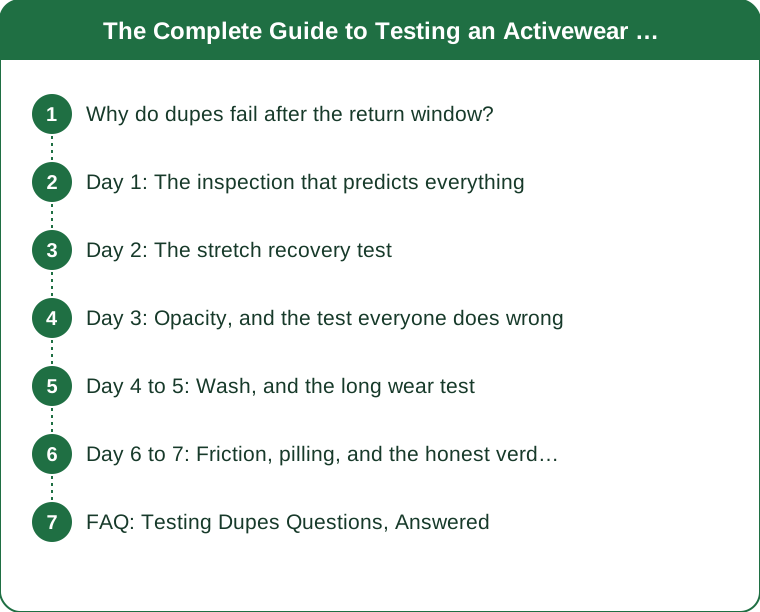
Why do dupes fail after the return window?
Because the failure modes are cumulative, and cumulative failures are invisible on day one - which the timing of return policies does not account for.
Pilling needs friction cycles. Pilling happens where fabric rubs against itself or against a surface: inner thighs, the seat, under a backpack strap. It typically becomes visible somewhere between 15 and 30 wears, which for most people lands at week six or later. On day one the fabric is flawless because the friction has not happened yet.
Elastane degrades with heat and time. The elastic fiber that provides stretch and recovery breaks down with washing, body heat, and especially dryer heat. Recovery loss is gradual - the waistband that rolls at week eight fit perfectly at week one, because the elastane had not yet been cycled enough times.
Seams fail under repeated load, not single load. A seam that holds a single deep squat may fail after 200 of them. Thread tension, stitch density, and seam type determine this, and none of it is visible from a single wear.
Opacity changes with stretch and wash. Fabric thins slightly as it is worn and washed. A pair that passes the squat test on day one can fail it at week ten, especially in lighter colors.
Meanwhile, returns are 30 days. Sometimes fewer, and often requiring unworn condition - which is precisely the tension. The honest strategy is to compress the wear you would do in six weeks into seven days, and to check the specific structural details that predict the rest.
Day 1: The inspection that predicts everything
Before wearing anything, spend ten minutes with the garment in strong daylight. This single session tells you more than the next three weeks of wearing will.
Check stitch density. Count stitches over an inch of a main seam. Denser stitching - roughly 10 to 14 stitches per inch - resists seam failure far better than sparse stitching around 6 to 8. Sparse stitching is the most reliable single predictor of a garment that will split.
Look for flatlock seams. Flatlock construction lies flat against the skin and distributes load across a wider area. Overlocked seams pressed to one side are cheaper, chafe more, and concentrate stress. Look at the inner thigh seam specifically, since it takes the most load.
Check the gusset. A diamond or triangular gusset at the crotch is a strong quality signal, because it removes the four-seam intersection that is the most common failure point. No gusset means the seams meet at a single stressed point - and that point is where most leggings tear.
Assess the waistband construction. A waistband made from multiple layers with an internal elastic band outperforms a simple folded-over one. Pull it and see whether it snaps back crisply or lags.
Weigh the fabric by feel. Hold it up to a window. Heavier fabric, generally 240 to 300 gsm, resists both sheerness and pilling better than lightweight fabric. If light passes through easily while relaxed, it will be sheer under stretch.
Smell it. A strong chemical odor out of the bag often indicates heavy finishing agents that wash out and take some of the hand feel with them.
Day 2: The stretch recovery test
This is the test that predicts sagging, bagging knees, and a rolling waistband - the complaints that dominate dupe reviews.
The method: lay the legging flat. Mark or note a four-inch section of fabric across the thigh. Stretch that section to its comfortable maximum, hold for 30 seconds, release, and wait 10 seconds. Measure again.
What to look for: good fabric returns to within about 5 percent of the original measurement almost immediately. If your four inches comes back at four and a quarter, that is a warning. If it comes back visibly loose or wavy, the garment will bag at the knees within a month.
Repeat at the waistband. The waistband takes the most repeated stress of any part of the garment. Stretch, hold, release, and watch whether it recovers crisply or stays slightly wide.
Then the two-hour version. Put them on and wear them for two hours around the house, sitting and standing normally. Take them off and look at the knees. Slight knee bagging after two hours means severe bagging by week six - this is the accelerated version of the failure, and it is a clear return signal.
Why this matters more than the feel: hand feel is largely about the surface finish, which is the easiest thing for a manufacturer to get right cheaply. Recovery is about fiber quality and knit construction, which is expensive, and it is where budget garments actually differ.

Day 3: Opacity, and the test everyone does wrong
The squat test is nearly universal and most people perform it in conditions that guarantee a pass.
Do it in the wrong lighting on purpose. Bright, direct light from behind or above - a window at midday, or a bathroom with strong overhead lighting. Bedroom lamps hide sheerness completely, which is why so many people discover the problem in a gym mirror instead.
Use a full range squat, and hold it. Go to your deepest comfortable squat and stay there for 20 seconds. Fabric thins under sustained stretch more than under a quick movement, and a quick dip does not reproduce what happens in a class.
Have someone photograph it, or use a phone timer. You cannot assess this yourself in a mirror at the angle that matters.
Test in the position you will actually be in. If you do yoga, test a forward fold. If you cycle, test a hinged-forward position. Sheerness is position-specific, and the squat is simply the most common stress case.
Check seated too. Sitting stretches the seat fabric differently than squatting, and a surprising number of garments pass one and fail the other.
A note on color: lighter colors and heathered fabrics show sheerness far more readily. If you are testing a light gray pair, you are testing the hardest case, and passing it is genuinely meaningful.
Day 4 to 5: Wash, and the long wear test
Two tests that must happen inside the window, and that most people postpone until it has closed.
Wash them exactly as you will actually wash them. Not extra carefully - your real routine. If you use a dryer, use it once here. The first wash reveals more than the next ten, because problems with dye, shrinkage, twisted seams, and finish loss appear immediately.
After washing, check four things: whether the leg seams have twisted so the inner seam has rotated toward the front, whether the color has bled onto anything, whether the fabric hand has changed noticeably, and whether the waistband still recovers as it did on day 2.
Twisting is a construction fault, not a laundry accident. It means the fabric was cut off-grain, and it never resolves - it worsens with every wash. It is a clear return.
Then the long wear test. A full six to eight hour wear day, including sitting, walking, stairs, and whatever workout you do. This is the closest single approximation of ordinary use.
What to watch for during it: waistband rolling or digging after hour three, the inner thigh seam becoming noticeable, any chafing point, the hem riding up, and whether you find yourself adjusting them. Counting the number of times you pull them up is the single most predictive measure of whether you will still be wearing them in six months. Anything above a handful of adjustments in a day means they will end up unworn.
Day 6 to 7: Friction, pilling, and the honest verdict
The last two days are about accelerating the slow failure and then making a decision without sentiment.
Accelerate the friction. The areas that pill are the ones that rub. Take a clean, dry hand towel and rub firmly across the inner thigh area for 60 seconds, then inspect in strong light. Good fabric shows nothing. Fabric that will pill shows the earliest fuzzing already, and once you see fuzz at 60 seconds of deliberate friction, you will see pills by week six.
Check the seat and under any strap line. Same test, same duration. These are the second and third most common pill zones.
Do one more recovery check. Repeat the day 2 stretch test on the washed, worn garment. Any meaningful loss of recovery after one wash and one long wear is disqualifying, because you are seeing degradation at a rate that will not slow down.
Then decide with a checklist, not a feeling. Return if: seams show any separation, recovery has visibly degraded, opacity failed in real light, twisting appeared after washing, or you adjusted them more than a few times in a wear day. Keep if: recovery held, opacity passed in bad lighting, the friction test showed nothing, and you forgot you were wearing them.
And record the result. A note with the brand, price, and outcome takes 30 seconds and turns individual purchases into actual knowledge. The value of the protocol compounds - after a handful of tests you can predict a brand’s quality from the product photos and the price, which is what stops the cycle of buying the wrong thing twice.
FAQ: Testing Dupes Questions, Answered
Does wearing them void the return?
Policies vary and this is the crux of it. Many retailers accept returns on tried-on items but not on washed or clearly worn ones. Read the policy before you start, and if washing voids the return, run days 1 to 4 first and decide before washing. A brand that does not permit any real testing is telling you something about its confidence.
Is a more expensive dupe automatically better?
No. Price correlates loosely with construction quality and not at all reliably at the middle of the market. The seven-day protocol is precisely what replaces price as a proxy, since a well-constructed mid-price garment routinely outperforms a poorly constructed expensive one.
How many pairs should I test at once?
One, properly. Testing three simultaneously means testing none of them - you will not do the friction test on all three, and you will keep the one that feels nicest, which is the least predictive signal available.
What if it passes everything and still fails at month four?
That happens, and it is a genuinely good outcome. A garment that survives this protocol and lasts four months has given you far more than the one that bagged at week six, and it has told you something reliable about that brand. Note it, and buy from them again.
Which single test matters most if I only do one?
The stretch recovery test on day 2. Recovery is the property that determines bagging, waistband rolling, and how the garment looks after 20 wears, and it is the property cheap manufacturing most consistently fails to deliver.
TL;DR:
- Dupes fail at week six while returns expire at 30 days - so compress six weeks of wear into seven days.
- Day 1 inspection predicts the most: stitch density of 10 to 14 per inch, flatlock seams, a real gusset, multi-layer waistband, 240 to 300 gsm fabric.
- Day 2 stretch recovery is the single most predictive test; anything that does not return within about 5 percent will bag.
- Test opacity in harsh light with a 20-second held squat, wash them the way you really wash things, and do one full six to eight hour wear day.
- Count how often you adjust them - that number predicts whether you will still be wearing them in six months.
What makes this worth the week is not any single test. It is that after three or four garments run through the same protocol, you stop guessing entirely - you can look at a listing, a price, and a photo of a waistband and know roughly what you are getting. That is the point where the dupe question stops costing you money twice.
See It in Motion
Seen here: High Waist Yoga Leggings with Side Pockets — shop it on bubblelime.com
Keep Reading
This article is for general informational and styling purposes only. Fit, sizing, and product availability may vary.