The Complete Guide to Judging an Activewear Dupe Before You Buy It
Quick Answer: You can predict most of a dupe’s quality from five data points before buying: fabric weight in gsm, fiber blend, seam type, whether there is a gusset, and how the waistband is constructed. Anything under roughly 200 gsm with a polyester-heavy blend and overlocked seams will disappoint regardless of how good the photos look. The return policy is the sixth data point, and for unfamiliar sellers it matters as much as the first five.
The dupe market has gotten genuinely good, which is exactly what makes it hard to navigate. Some lookalikes are made in adjacent factories with near-identical specs. Others are a completely different product wearing the same silhouette.

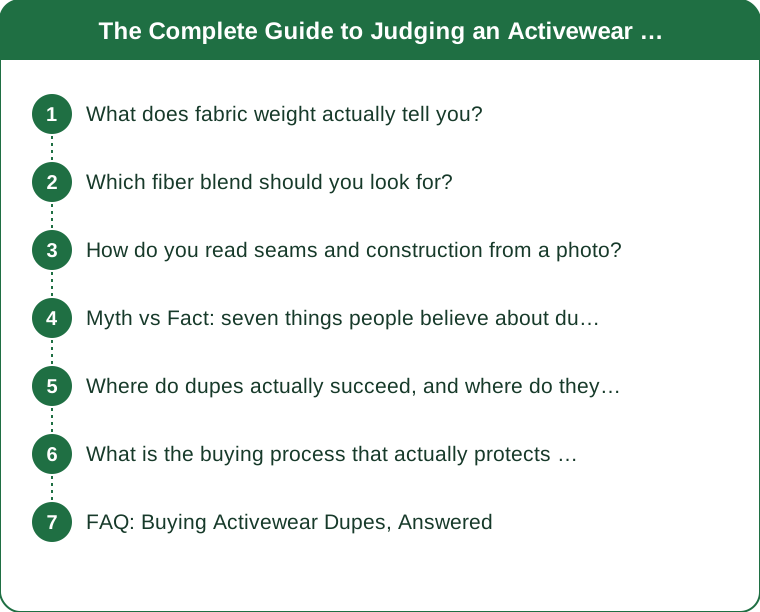
What does fabric weight actually tell you?
Fabric weight, measured in grams per square meter, is the single most predictive number available and the one most sellers omit.
Under 180 gsm is a light knit. It works for a loose tank or a summer short and it will be sheer as a legging.
200 to 240 gsm is the sweet spot for most warm-weather leggings - opaque, breathable, comfortable for a full day.
250 to 300 gsm is the premium compression range. Substantial, smoothing, opaque, and genuinely warm.
Above 320 gsm is winter or heavy compression territory.
When a listing omits gsm, the fallback signals are price and photos. A legging priced at a quarter of the original that photographs with visible highlight sheen at the thigh is usually a light polyester knit.
The squat test everybody references is really a weight and knit-density test. You can predict the outcome before it arrives.
Which fiber blend should you look for?
Two families dominate, and they behave differently.
Nylon and spandex, typically 70 to 80 percent nylon. Nylon is softer, more durable against abrasion, wicks better and holds color well. It is more expensive, and it is what most premium activewear uses.
Polyester and spandex. Cheaper, dries slightly faster, resists stretching out, and tends to feel less soft and hold odor more. It also takes sublimation printing better, which is why bold prints are so often polyester.
Spandex content matters independently: below 12 percent tends to lack recovery and bag out at the knee. 18 to 25 percent gives real compression and shape retention.
A useful rule: if the listing says only polyester and spandex with no percentages, assume the spandex content is on the low end. Sellers advertise high spandex content when they have it.
One caveat - a well-made polyester legging beats a poorly made nylon one. Blend is a strong signal, not a verdict.
How do you read seams and construction from a photo?
This is where dupes most often reveal themselves, and it is visible in product images if you know what to look for.
Flatlock seams lie flat with a visible parallel stitch pattern and no ridge. They do not chafe and they are more expensive to produce.
Overlocked seams create a raised ridge inside. On a legging inner thigh, that ridge is what causes irritation on a long walk, and it is also the first place a seam fails.
The gusset is the diamond or triangular panel at the crotch. Its presence means the seams do not converge at a single stress point, which is the main cause of the blowout that happens at month three. A missing gusset is the most reliable predictor of early failure.
Zoom into the product photos at the inseam and the crotch. Reputable sellers photograph both because they are selling the construction. Sellers who hide those angles are usually hiding something.
Also check the waistband: a doubled fabric band with a drawcord channel is a good sign; a thin elastic sewn into a single layer is not.

Myth vs Fact: seven things people believe about dupes
Myth: Dupes come from the same factory as the original. Fact: sometimes true, mostly not. Adjacent factories in the same region can produce genuinely comparable goods, but the specific claim is almost always unverifiable marketing.
Myth: Price is a reliable quality signal. Fact: it correlates loosely and breaks constantly. Brand markup, marketing spend and retail overhead all inflate price without touching the fabric.
Myth: If it looks the same in photos it wears the same. Fact: photos capture silhouette and color. They do not capture recovery, pilling resistance, opacity under stretch, or how the waistband behaves at hour six.
Myth: Reviews will tell you. Fact: reviews are useful for fit and sizing and nearly useless for durability, because most are written within two weeks of purchase - before the failure modes appear.
Myth: You should buy your usual size. Fact: sizing varies enormously across manufacturers, and the third mistake most people make is ordering one size without checking the actual measurement chart in inches.
Myth: A cheap dupe is a low-risk experiment. Fact: it is low risk only if returns are free. Otherwise a twenty-dollar item you will not wear is a total loss, not a discount.
Myth: All dupes are worse. Fact: plenty are genuinely good, especially in simple constructions like bike shorts and tanks where there is less engineering to get wrong.
Where do dupes actually succeed, and where do they reliably fail?
The pattern is consistent enough to plan around.
They succeed on simple garments. Basic tanks, bike shorts, sports bras with light support, and straightforward leggings in solid dark colors. There is less engineering involved and the gap between a good and a great version is small.
They also succeed on trend items you will wear for one season. Paying premium prices for a silhouette that will feel dated in eight months is a poor allocation regardless of quality.
They reliably fail on high-support sports bras, where the engineering - band construction, cup structure, strap anchoring - is the entire product and is expensive to get right. This is the one category worth buying carefully.
They fail on anything relying on proprietary fabric technology, and on complex constructions with many panels, where a small pattern error compounds.
They fail on light colors, where opacity problems become obvious immediately.
A practical allocation: buy dupes for shorts, tanks, dark leggings and trend pieces. Buy carefully for high-impact bras and for the two or three pairs you will wear weekly for years.
What is the buying process that actually protects you?
Six steps, in order:
One. Find the gsm. If it is not listed, message the seller - a seller who answers with a real number is usually selling a real product.
Two. Check the fiber percentages. Nylon-rich with 18 percent or more spandex is the target for leggings.
Three. Zoom into inseam and crotch photos looking for flatlock seams and a gusset.
Four. Read the measurement chart in inches and compare against a garment you already own, laid flat. Never order by size label alone.
Five. Read the return policy before adding to cart. International returns that require paid shipping back mean the item is effectively final sale, and that changes the math entirely.
Six. Order one item, not five. The strong temptation with cheap prices is to buy the whole set. Buy one, wear it for two weeks including at least three washes, and then decide.
That two-week test is the only thing that catches the failure modes that matter: pilling at the inner thigh, waistband roll, opacity loss after washing, and elastic that stops recovering.
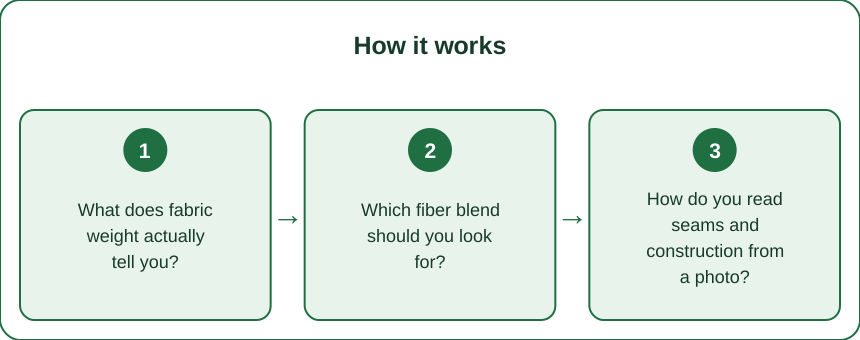
FAQ: Buying Activewear Dupes, Answered
What gsm should I look for in summer leggings?
Roughly 200 to 240 gsm gives opacity without excessive heat. Below 200 tends to be sheer under stretch and above 260 gets warm in August.
How can I tell if leggings will be see-through before buying?
Fabric weight and knit density are the predictors, plus color - light colors and heathered fabrics show through more at the same weight. If a seller will not state gsm and only photographs the item on a dark background, be cautious.
Is it worth buying a dupe of a high-support sports bra?
Usually not. Band construction and strap anchoring are the expensive engineering in a bra, and they are the parts that get cut. This is the one category where paying more consistently buys something real.
How many washes before I know if it will last?
Three washes reveals most early problems - pilling, color loss, elastic recovery. Anything that survives three washes and two long wears is usually fine for a season.
TL;DR:
- Five predictive data points: gsm, fiber blend, seam type, gusset presence, waistband construction. Return policy is the sixth.
- Target 200 to 240 gsm and nylon-rich blends with 18 percent or more spandex for summer leggings.
- A missing gusset is the most reliable predictor of early failure; zoom into the crotch and inseam photos.
- Dupes succeed on shorts, tanks and dark leggings; they reliably fail on high-support bras.
- Buy one item, wash it three times, then decide - reviews written in week one cannot tell you what matters.
The useful skill is not finding dupes, since the internet supplies more than anyone needs. It is reading a product page well enough to know which ones will still be in your rotation next summer. Five numbers and a couple of zoomed-in photos will tell you more than any review roundup, and they take about ninety seconds to check.
See It in Motion
Seen here: High Waist Embossed Yoga Leggings with Side Pockets — shop it on bubblelime.com
Keep Reading
This article is for general informational and styling purposes only. Fit, sizing, and product availability may vary.