The Complete Guide to Judging Activewear by Its Waistband
Quick Answer: The waistband concentrates more construction decisions than any other part of a legging - number of panels, elastic type, stitch construction, fabric weight, and finishing. A high waistband made from a single tube of the same fabric as the leg will roll. One built from multiple panels with a separate inner elastic or a bonded edge will not. Turn it inside out and count the seams: that one check separates most price tiers.
Everything else about a legging can be assessed by wearing it. The waistband can be assessed before you buy.

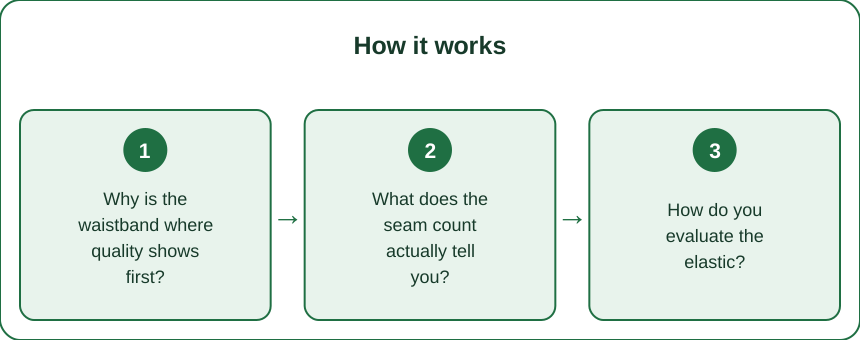
Why is the waistband where quality shows first?
Because it is under the most complex load of any part of the garment, and because it is where manufacturers cut costs most quietly.
A legging’s waistband has to do several contradictory things simultaneously. It must hold the entire garment up against gravity plus the drag of the fabric below it. It must resist rolling downward when you bend forward. It must stretch enough to get on and then recover fully to grip. And it must do all this over a part of the body that changes circumference substantially between standing and sitting, and between morning and evening.
No single fabric does all of those well. A fabric stretchy enough to pull on easily lacks the recovery to grip; a fabric with strong recovery is uncomfortable to pull on and digs.
The solution any competent manufacturer arrives at is construction - combining fabrics, adding elastic, using multiple panels, and shaping the band rather than making it a straight tube.
Each of those solutions costs money. A single-tube waistband is one pattern piece and two seams. A three-panel contoured waistband with bonded edges and internal elastic is five pattern pieces, six seams, and a specialized machine.
Which means the waistband is where the manufacturer’s actual budget becomes visible, in a way that the leg fabric - which looks similar across price points - does not.
What does the seam count actually tell you?
It tells you whether the band was shaped or simply cut.
Turn a legging inside out and look at the waistband. You are counting horizontal seams - seams running around the circumference.
Zero horizontal seams means the waistband is continuous with the leg fabric, folded over and stitched at the top. This is the cheapest construction. It always rolls at some point, because there is nothing resisting the fold except the fabric’s own stiffness.
One horizontal seam means a separate waistband piece was attached to the leg. Better - the waistband fabric can differ from the leg fabric, usually with a higher elastane content. Most mid-priced leggings are here.
Two or more horizontal seams means the waistband was built from multiple panels. This is what allows contouring - making the band narrower at the front and wider at the back, or curving the top edge to follow the natural waist. A contoured band follows the body’s actual shape, which is why it does not roll: there is no excess fabric to fold over.
Vertical seams at the sides or back indicate additional shaping, usually a V or curved back panel that accommodates the difference between waist and hip circumference.
The rough heuristic: more seams in the waistband generally means more engineering, not more cost-cutting. This is the opposite of the usual assumption that fewer seams equals higher quality, and it is one of the more useful counterintuitive things to know when shopping.
How do you evaluate the elastic?
By feel and by a specific stretch test, both of which take fifteen seconds.
There are three common approaches inside a waistband.
No separate elastic. The band relies entirely on the fabric’s elastane content. Feel for it - a band with no internal elastic feels uniform in thickness throughout. This construction is comfortable and rolls easily.
A separate elastic band enclosed inside. You can feel a distinct firmer strip, usually 20 to 40mm wide, when you pinch the band. This resists rolling well but can create a visible line under fitted tops and sometimes twists inside the casing over time.
Bonded or laminated construction. No stitching visible at the top edge; the fabric layers are fused. This is the most expensive approach and produces the smoothest exterior with no seam line. A bonded top edge is one of the strongest single quality indicators in activewear, because the equipment required is a significant investment.
The stretch test: pinch the waistband with both hands about six inches apart and stretch it. Then release. Watch what happens.
Good recovery returns to the original dimension immediately with no visible slack. Poor recovery leaves a slightly wavy or loose section. Repeat this three or four times in quick succession - fatigue after a few stretches predicts how the band will behave after a few months, and cheap elastic reveals itself quickly under this test.

What about fabric weight and the roll problem specifically?
Weight is the variable most people never check, and it explains most of the difference between two leggings that look identical online.
Activewear knit weight is measured in grams per square meter (GSM). Typical ranges:
- Under 200 GSM: lightweight, often sheer when stretched, common in warm-weather and yoga leggings. Rolls readily unless well constructed.
- 220 to 280 GSM: the mainstream range for compressive leggings. Good balance of opacity, support, and breathability.
- 300+ GSM: heavyweight, high compression, warm. Very resistant to rolling, less breathable, and noticeably more expensive because there is simply more material.
Most brands do not publish GSM, which is unhelpful, but you can assess it by hand - hold the fabric up to light and stretch it. Substantial resistance and no visible light through means a heavier knit.
Why weight matters for rolling: rolling happens when the waistband’s top edge is pushed downward by the body and the fabric lacks the stiffness to resist folding. A heavier fabric has more bending resistance. This is why a 300 GSM legging in a plain single-seam construction may roll less than a 180 GSM legging with a fancy contoured band.
The combination that genuinely does not roll: heavier fabric plus contoured multi-panel construction plus a bonded or firmly stitched top edge. Any two of the three usually gets you most of the way.
One caveat for the season - a heavier legging that was unbearable in July is exactly right for October, which is worth remembering before you judge a piece by how it felt in high summer.
What Nobody Tells You About the Inside of the Band
Two details on the interior of the waistband predict long-term comfort better than anything on the outside.
The stitch type on the inner seam. Look at the seam where the waistband attaches to the leg, from the inside. A flatlock stitch - which lies flat with no raised ridge - is comfortable against skin and adds durability. A serged or overlocked seam creates a raised ridge with loose thread loops. Under a compressive garment worn for two hours, that ridge presses into you at exactly the level of the natural waist.
On a legging worn for a workout, either is tolerable. On a legging worn for a full day, the difference is significant.
Silicone grip. A thin strip of silicone dots or a band on the inside of the top edge is a genuine functional feature, particularly on high-rise designs. It stops the band migrating downward through friction rather than through fabric stiffness. Feel for it - it is slightly tacky.
The caution: silicone grip degrades with fabric softener and with high heat drying. A legging with silicone grip that has been through a dryer twenty times often no longer has functional grip. If you buy for this feature, wash cold and hang dry.
There is also a diagnostic use for this. If a legging that used to stay put has started rolling, and it has silicone grip, the grip has probably failed rather than the fabric having stretched out - which is a laundry problem rather than a garment quality problem.
5 Waistband Checks to Do in the Fitting Room
-
Turn it inside out and count horizontal seams. Zero means a rolled hem construction and near-certain rolling. Two or more means contoured panels.
-
The repeated stretch test. Pinch and stretch the band four times in a row and watch recovery on the fourth. Fatigue that appears in four stretches will appear badly in four months.
-
Bend forward fully while wearing them. This is the position that causes rolling, and it takes two seconds. If it rolls in the fitting room, it will roll everywhere.
-
Squat and check the back rise. Waistband gapping at the back when you squat means the back rise is too short for you - a fit issue that no waistband construction fixes.
-
Feel the inner seam with a fingertip. Flat means flatlock; a raised ridge with visible thread loops means overlocked. Judge by how long you intend to wear them.
All five together take under two minutes and tell you more about how a legging will perform over a year than any amount of online review reading. The second and third are the highest-yield if you only do two.
FAQ: Waistband Quality Questions, Answered
Does a wider waistband always mean less rolling?
No. Width without construction makes rolling worse, because there is more fabric available to fold. A 5-inch single-tube band rolls more readily than a 3-inch contoured one. Width helps only when combined with shaping or internal elastic.
Is a drawstring a good sign or a bad one?
Usually neutral, and occasionally a sign that the band alone is not trusted to hold. Functional drawstrings are genuinely useful for people between sizes. A purely decorative one is a styling choice with no bearing on quality.
Do pockets in the waistband weaken it?
A well-constructed side pocket does not, because it is built into a panel seam. A pocket cut into an otherwise unshaped band can create a weak point and asymmetric stretch, which shows up as one side sitting lower over time.
My expensive leggings roll and my cheap ones do not. Why?
Most likely fabric weight. A premium lightweight legging designed for hot-weather yoga can roll more than an inexpensive heavyweight one designed for the gym. Price signals materials and finishing; it does not directly signal roll resistance, which is largely a weight and geometry question.
TL;DR:
- The waistband concentrates more construction decisions than any other part of a legging, so it is the fastest quality read.
- Count horizontal seams from the inside: zero means a folded hem that will roll, two or more means contoured panels.
- A bonded top edge with no visible stitching is one of the strongest quality signals available.
- Do the repeated stretch test four times - elastic that fatigues in four stretches will fatigue in four months.
- Fabric weight matters as much as construction; heavier knits resist rolling through bending stiffness alone.
- Check the inner seam for flatlock versus overlocked, and remember silicone grip dies in a hot dryer.
Two minutes with a legging turned inside out tells you more than an hour of reading reviews, and it works at every price point.
See It in Motion
Seen here: High Waist Yoga Leggings with Side Pockets — shop it on bubblelime.com
Keep Reading
This article is for general informational and styling purposes only. Fit, sizing, and product availability may vary.