The Complete Guide to Judging a Fleece-Lined Legging Dupe
Quick Answer: Fleece-lined leggings fail in ways photos cannot show: pilling of the brushed interior, loss of compression after the first wash, seam bulk that chafes, and opacity that disappears when the fabric stretches over the thigh. The four checks that predict most of it: fabric weight in gsm (look for 240+), elastane content of 18-25%, flatlock or bonded seams, and a squat test on day one. A good dupe exists in this category; a cheap one almost never does.
This is the category where the price gap is most defensible and also where a well-chosen alternative saves the most money. Both things are true, and the difference is entirely in what you check before wearing them outside.

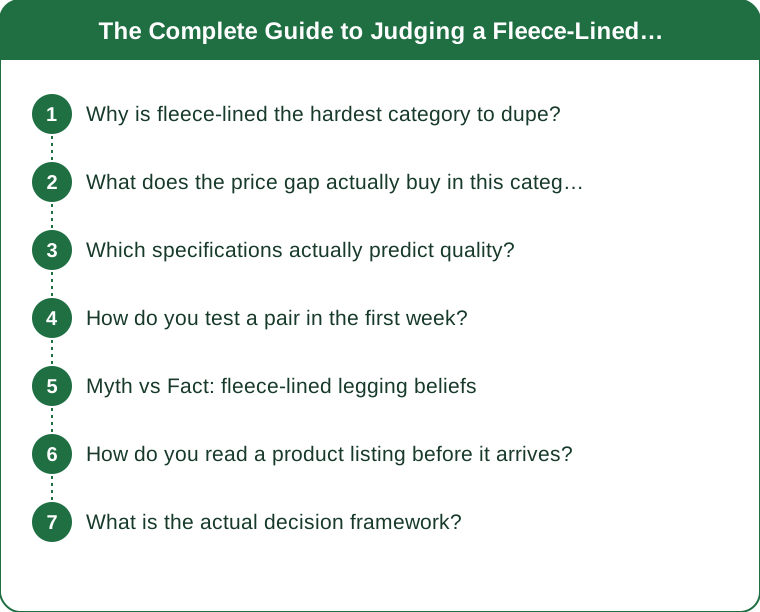
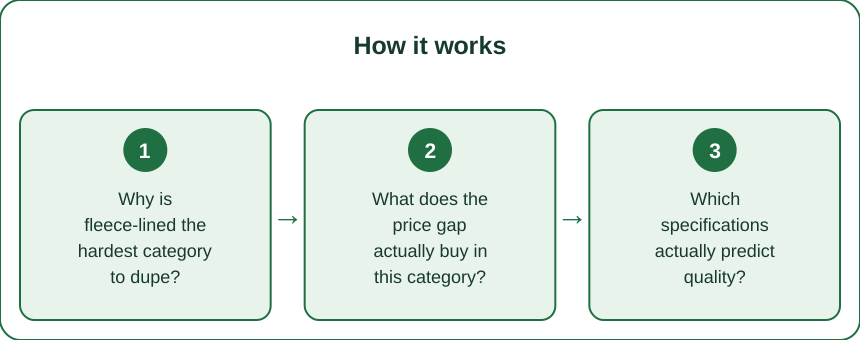
Why is fleece-lined the hardest category to dupe?
A standard legging has one job: stretch, recover, and stay opaque. A fleece-lined legging has to do all of that while carrying a second layer bonded or knitted to the inside, and that second layer changes every variable.
The brushed interior adds thickness without adding strength. The fleece side is created by mechanically raising fibers from the knit or by laminating a separate layer. Both processes weaken the base fabric slightly. A manufacturer cutting costs uses a thinner base to keep the total weight in the target range, and the result is a legging that feels thick in hand and goes sheer under stretch.
Recovery is harder to engineer. The lining resists the stretch-and-return cycle differently from the face fabric. When the two layers have different recovery rates, the legging bags at the knee within a few wears - the single most common complaint in this category and the one that never shows up in a photo.
Seams carry more bulk. Two layers means twice the material in every seam. A well-made pair uses flatlock or bonded seams to keep the profile low; a cheap pair uses a standard overlock that produces a ridge you will feel on a long walk.
And pilling. The raised interior fibers are, by design, loose. On a quality fabric they are anchored well and long-staple; on a cheap one they are short-staple and shed into pills within a handful of wears, which then reduces warmth and feels rough.
What does the price gap actually buy in this category?
More than in most activewear categories, and it is worth being specific about where.
Base fabric quality. Higher-priced pairs generally use a longer-staple, finer-denier yarn in the face fabric. This is what determines opacity under stretch and how the fabric ages. It is the most expensive input and the least visible one.
Elastane content and quality. Premium pairs typically run 18-25% elastane, and use branded elastane with better documented recovery. Cheap pairs often run 8-12%, which feels adequate new and loses shape fast.
Construction method. Bonded or flatlock seams, gusseted crotch, and a properly constructed waistband with multiple layers of stabilizing tape. The gusset in particular is a real durability feature - the crotch seam is the highest-stress point in a legging, and a diamond or triangular gusset spreads that stress across four seams instead of concentrating it at one intersection.
Consistency. The most underrated difference. A premium brand’s pair-to-pair consistency is high; a budget brand’s can vary considerably between production runs, which is why reviews for cheap leggings are so polarized - reviewers received genuinely different products.
What the gap does NOT buy: warmth, primarily. Fleece lining thickness is not a premium feature and budget pairs are frequently just as warm. Nor does it buy fit range, style, or color. The gap buys durability and opacity, not comfort on day one - which is exactly why dupes feel so convincing in the store and disappoint at month four.
Which specifications actually predict quality?
Five numbers and features to look for, in order of predictive value.
1. Fabric weight (gsm). Grams per square meter is the most useful single number, and brands that publish it are usually confident about it. For fleece-lined leggings, 240-320 gsm is the useful range. Under 220 gsm is likely thin somewhere. Over 340 gsm gets genuinely bulky. If it is not published, weigh the pair on a kitchen scale - a size medium in a good fleece-lined legging typically comes in around 280-380 grams total.
2. Elastane percentage. 18-25% is the target. Below 15%, expect knee bagging. This is printed on the label, so it is the easiest check to make.
3. Seam type. Flip them inside out. Flatlock seams look like a flat ladder of stitching; bonded seams have no stitching at all. Both are good. A raised ridge with overlocked edges is the budget construction and it will chafe on anything over an hour.
4. Gusset. Look for a diamond or triangular panel at the crotch. Its absence is the strongest single predictor of a seam failure in month three.
5. Waistband construction. A single folded band with elastic threaded through is the cheap version. A multi-panel band with a stabilizing tape and a proper cover stitch holds up. Stretch the waistband hard and watch it return - if it hesitates, it will not survive a season.
Ignore entirely: thickness in the hand, softness of the fleece, and how good it looks flat. All three are trivially cheap to fake and none correlate with durability.

How do you test a pair in the first week?
You have a return window. Use it deliberately rather than wearing them once and hoping.
Day 1 - the opacity test. Put them on, squat fully in front of a mirror in bright light, and have someone photograph the back with flash. Flash photography is far harsher than daylight and will show sheerness that your bathroom mirror hides. Also check while sitting, with the fabric stretched over the thigh - many pairs pass a standing squat and fail seated.
Day 1 - the seam check. Wear them for at least two hours including sitting, walking, and stairs. Chafing seams announce themselves within that window. Pay attention to the inner thigh and the back of the knee.
Day 2 - the recovery test. Wear them for a full day, then look at the knees and seat. Some bagging is normal. Bagging that does not disappear after an hour off the body means the recovery is inadequate, and it will only get worse.
Day 3 - the first wash. This is the decisive test. Wash cold, hang dry, and then compare: do they still measure the same laid flat? Has the waistband loosened? Has the interior started pilling anywhere? A pair that pills after one wash will be unwearable by January.
Day 4-7 - the warmth test in real conditions. Fleece lining performs very differently in dry cold versus wet cold. If they are for outdoor use, wear them outdoors before the return window closes.
The one thing not to do: wash them and put them in the dryer during the test week. Heat damages elastane, and you will have lost the return option for a failure you caused.
Myth vs Fact: fleece-lined legging beliefs
Myth: Thicker fleece means warmer. Fact: warmth comes from trapped air, not fabric mass. A dense, heavily compressed fleece can be less warm than a lofted lighter one. It also compresses under a tight legging, which is why very thick linings under high compression underperform their thickness.
Myth: If it feels soft in the store, the fleece is good quality. Fact: initial softness comes from surface finish and can be produced cheaply with fabric treatments that wash out. Judge fleece by fiber length and density, not by how it feels on the shelf - look closely at whether the raised fibers are uniform or already showing loose clumps.
Myth: A dupe from the same factory is the same product. Fact: factories run to specification. The same facility produces different quality at different price points using different yarns, different elastane, and different construction. The factory claim is close to meaningless without matching specifications.
Myth: Fleece-lined leggings work for training. Fact: they are designed for warmth and generally handle sweat poorly - the lining holds moisture against the skin. They are excellent for walking, commuting, standing outdoors, and lounging, and mediocre for anything that makes you sweat significantly. Choose a proper thermal training tight for that.
Myth: They should be sized up because of the lining. Fact: most brands account for the lining in the pattern. Sizing up usually produces a legging that slips at the waist and bags at the knee, because the compression that holds them up is gone. Size normally and check the recovery instead.
How do you read a product listing before it arrives?
Most of the assessment happens before you pay, if you know where to look.
Read the fabric composition first, not the description. The description is marketing; the composition is regulated. A listing that says thermal brushed premium fabric and then lists 92% polyester / 8% spandex has told you the elastane is too low regardless of everything above it.
Look for a published weight or a stated thickness. Brands confident in their fabric publish gsm. Brands that are not describe it in adjectives. This correlation is strong enough to use as a filter.
Zoom into the interior photo. Most listings include at least one shot of the lining. What you are looking for is uniform, dense pile. Visible base fabric showing through the fleece, or clumped fibers, means a thin or poorly anchored lining that will pill.
Read the three-star reviews, not the one-star or five-star ones. One-star reviews are usually about shipping or sizing; five-star reviews are usually written within a week of delivery, which is before any of the real failure modes appear. Three-star reviews from buyers who mention washing them are the most informative text on the page.
Search reviews for specific words: pill, sheer, see-through, baggy, knee, waistband, shrink. Sorting for those terms surfaces the durability signal buried under hundreds of comments about how soft they are.
Check the return policy before anything else. In this category the return window is the actual product guarantee. A 30-day window is enough to run the full week-one test; a 14-day window with a restocking fee is not, and that changes what specification risk you can afford to take.
And note the review dates. A flood of reviews clustered within a few days of each other, all glowing and all short, is a pattern worth discounting.
What is the actual decision framework?
Bringing it together into something you can apply in a store or a checkout page.
Buy the premium version when: you will wear them multiple times a week for a full season, you need genuine opacity for a workplace or public setting, you have had recovery problems with budget pairs before, or the cost per wear over two seasons genuinely favors it. A $90 pair worn 100 times is cheaper per wear than a $25 pair replaced twice.
Buy the dupe when: it meets the four specification checks (gsm, elastane, seams, gusset), it is for occasional or single-season use, the return policy is genuinely usable, or the style is one you are trying rather than committing to.
Do not buy either when: the specifications are not published and the return policy is restrictive. That combination is where the money actually gets wasted, regardless of price point. An unpublished spec plus a no-return policy is a gamble, and in this category the odds are poor.
The cost-per-wear math nobody does: work out how many times you will realistically wear them this season. Fleece-lined leggings are seasonal, roughly a four-month window in most climates. At three wears a week that is around 50 wears a season. A pair that survives two seasons at $80 is $0.80 per wear; a pair that dies mid-season at $25 is $0.50 per wear but leaves you cold in January and buying again.
And the honest conclusion: in most activewear categories dupes have closed the gap substantially. In this one they have not, because the failure modes are in the least visible parts of the construction. A well-specified mid-price pair usually beats both the cheapest dupe and the premium flagship on value.
TL;DR:
- Fleece-lined is the hardest dupe category because failures - pilling, knee bagging, stretch sheerness, seam bulk - are invisible in photos.
- Check four things: 240+ gsm, 18-25% elastane, flatlock or bonded seams, and a gusset.
- Test in week one: flash-photo squat test, two-hour wear, and one cold wash before the return window closes.
- Thickness and softness in the hand predict nothing. Fabric weight and elastane content predict most of it.
This is the one category where the price gap is genuinely earned - not in warmth, but in whether the pair still works in February. Check the four specifications and the decision usually makes itself.
See It in Motion
Seen here: High Waist Yoga Leggings with Side Pockets — shop it on bubblelime.com
Keep Reading
This article is for general informational and styling purposes only. Fit, sizing, and product availability may vary.