The Complete Guide to Dupe Sizing — Why the Same Size Fits Completely Differently
Quick Answer: Dupes rarely match the original’s fit because they copy the visible design and not the pattern grading, the fabric’s stretch ratio, or the recovery rate. The result is that a dupe in your usual size is frequently correct at the waist and wrong at the hip, or correct when new and wrong after six weeks. Measure the garment flat and compare to the original rather than trusting size labels.
The dupe economy runs on one implicit promise: same look, same fit, a fraction of the price. The look part is often delivered convincingly. The fit part almost never is, and the reasons are structural rather than a matter of one brand cutting corners.
Understanding why turns dupe buying from a lottery into something closer to a decision.

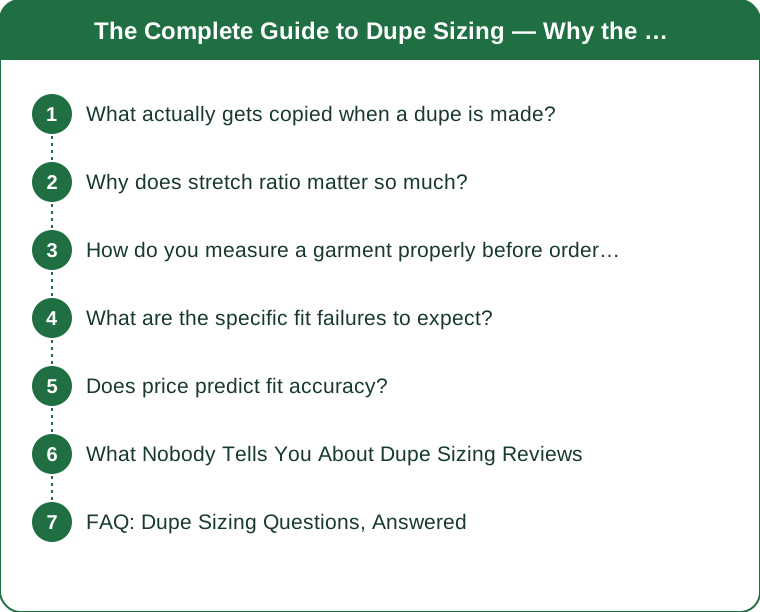
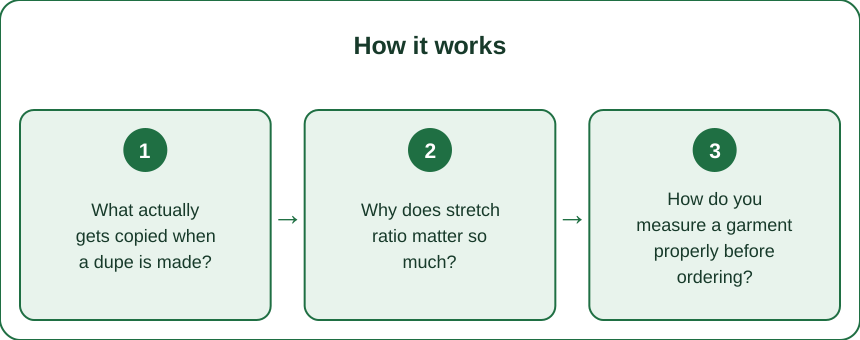
What actually gets copied when a dupe is made?
Less than most people assume, and the gap explains almost everything that follows.
A dupe is typically reverse-engineered from a purchased sample of the original. Someone takes it apart, traces the panels, notes the seam construction, and sources the closest available fabric. What that process captures is the silhouette and the visible construction. What it does not capture is everything invisible.
Pattern grading is not captured. Grading is the rule set that determines how a pattern changes between sizes — how much is added at the waist versus the hip versus the thigh when going from a size 8 to a size 10. Every brand grades differently, based on their own fit model and their own customer data. Reverse-engineering one physical garment gives you one size. The other sizes are generated using the copying factory’s standard grading rules, not the original’s.
This is why dupes so often fit well in one size and badly in the size above or below, and why reviews are wildly contradictory. The people saying it fits perfectly and the people saying it runs small are frequently both right about their own size.
Fabric behaviour is not captured either. Two fabrics can have identical weight and identical composition on paper and behave completely differently, because stretch ratio, recovery rate and yarn construction all vary. A pattern drafted for a fabric with 40 percent stretch will fit differently in a fabric with 55 percent stretch, even if every measurement of the flat garment is identical.
Why does stretch ratio matter so much?
Because activewear patterns are drafted with negative ease — the garment is deliberately made smaller than the body and relies on stretch to fit.
A typical legging might be drafted at 15 to 25 percent negative ease, meaning a garment intended for a 90cm hip measures roughly 70cm around when flat. The fabric stretches to fit and the tension it exerts is what produces the compressive, held-in feel.
Now change the fabric to one with more stretch and less recovery. The garment still fits over the hip — more easily, in fact — but it exerts less tension, so it feels loose, slides down, and does not hold shape. Change to a fabric with less stretch and the same garment becomes uncomfortably tight and may not go on at all.
Two-way versus four-way stretch compounds this. Four-way stretch fabric moves both across and along the grain; two-way moves in one direction only. A pattern drafted for four-way stretch made up in two-way fabric will feel restrictive in the direction that no longer gives, usually vertically, which presents as the waistband pulling down when you squat.
Recovery is the slow version of the same problem. Recovery is how completely a fabric returns to its original dimensions after being stretched. A high-recovery fabric holds its fit for hundreds of wears. A low-recovery fabric fits correctly for the first few and then progressively bags at the knee and seat.
This is why so many dupe reviews are positive in week one and negative in month three. The garment did not fail. Its recovery was always going to be the difference, and recovery is invisible at the point of purchase.
How do you measure a garment properly before ordering?
The only reliable method is to compare flat garment measurements, not size labels or body size charts.
If you own the original, measure it. Lay it flat on a hard surface without stretching, smooth out wrinkles, and take these five measurements:
1. Waistband width, flat, relaxed. Measure straight across the top edge. Double it for circumference. 2. Waistband height. From top edge to the seam where it joins the body. 3. Hip width, flat. Measure across at the widest point, usually 18 to 20cm below the waistband. 4. Inseam. Crotch seam to hem along the inside leg. 5. Thigh width, flat. Measure across 2cm below the crotch seam.
Then ask the dupe seller for the same measurements, or find them in a review. Reputable dupe sellers frequently publish flat measurements because they know this is how their customers shop.
The tolerance that matters: within 1.5cm on waist and hip flat measurements, the fit will feel comparable. Beyond 2.5cm, it will feel like a different garment.
One more measurement worth taking, and almost nobody does: the stretch test. Hold a 10cm section of the waistband and stretch it as far as it comfortably goes. Measure. A waistband stretching from 10cm to 15cm has 50 percent stretch; one going to 18cm has 80 percent. If the dupe’s stretch percentage differs from the original’s by more than about 15 points, the fit experience will differ regardless of the flat measurements matching.

What are the specific fit failures to expect?
Five recurring patterns, each with a different cause and a different workaround.
Waistband too loose at the top, correct at the hip. The most common single complaint. Usually caused by grading differences — the copying factory’s rules add more at the waist than the original’s do. Workaround: size down and accept a snugger hip, or choose a dupe with a crossover or drawcord waist that can be adjusted.
Correct at the waist, tight through the thigh. The reverse grading problem, common on dupes made for markets with different average body proportions. Frequently reported on dupes of US brands made for Asian markets. No good workaround — size up and accept waistband looseness.
Inseam wrong by 2 to 4cm. Very common and rarely mentioned in listings. A 7/8 length legging becomes full length or a cropped one, depending on the direction. Check the inseam number specifically; it is the single most frequently mismatched measurement.
Correct when new, loose after six weeks. Recovery failure. No workaround at the point of purchase except buying from sellers with a track record. This is the failure that makes cheap dupes expensive.
Rise measurement off. A high-rise dupe with a rise 3cm lower than the original changes the entire silhouette and how it sits on the torso. Rise is almost never published and is worth asking about, because it is the measurement most responsible for whether something looks like the original when worn.
Does price predict fit accuracy?
Loosely, and not in the way most people assume.
What price does predict reasonably well is fabric quality and recovery. A dupe at 15 percent of the original’s price is almost certainly using a cheaper fabric with lower recovery, because fabric is the largest input cost in activewear. A dupe at 50 percent of the original’s price may well be using a comparable fabric.
What price predicts poorly is pattern accuracy. Grading is a fixed development cost that does not scale with the retail price, and a cheap dupe and an expensive one may both be using the same copied pattern from the same factory. There is a well-documented pattern of multiple brands selling visually identical garments from a shared source at very different prices.
The practical implications:
- If your priority is how it fits on day one, price is a weak signal. Measurements are the signal.
- If your priority is how it fits in six months, price is a moderately good signal, because it correlates with fabric.
- Mid-priced dupes are frequently the worst value, because they carry a price premium without a corresponding fabric upgrade.
A reasonable rule: buy the cheapest version of a dupe for a style you are unsure about, and if you love it and wear it out in four months, that is useful information — either buy the original, or buy the same dupe again knowing the replacement cycle. Four months of wear for fifteen dollars is not a bad outcome. Four months of wear for sixty is.
What Nobody Tells You About Dupe Sizing Reviews
Reviews are the main tool people use and they are systematically distorted in ways worth understanding.
Size-specific experiences get aggregated. Because of the grading problem, a product with excellent fit in sizes S and M and poor fit in L and XL produces an average review score that describes nobody’s experience. Read reviews from people who state their size and measurements, and ignore the star average entirely.
Recovery failures are underrepresented. Most reviews are written within two weeks of delivery, which is before recovery problems appear. A product with a 4.6 star average from reviews written at week two may have a very different real-world score at month four. Sort by most recent and look specifically for reviews mentioning a duration.
Photographs are unreliable for fit. Fit photos are taken standing still. The failures that matter — waistband rolling, sheerness under stretch, knee bagging — appear during movement. Video reviews are far more informative than photo reviews for this reason.
Incentivised reviews skew early. Products frequently launch with a wave of incentivised or gifted reviews, which are disproportionately positive and disproportionately early. The reviews from three to six months after launch are the honest ones.
Height is more informative than size. A reviewer’s height tells you about inseam and rise fit more reliably than their size does. Look for reviewers within 3cm of your height before you look for reviewers in your size.
FAQ: Dupe Sizing Questions, Answered
Should I size up or down in dupes generally?
There is no general rule, and advice to always size up is one of the more expensive pieces of internet folklore. Grading differences go both directions. Measure, or order two sizes and return one where returns are free.
What if the seller does not publish measurements?
Ask. Many will provide them. If a seller will not or cannot supply flat measurements, that is meaningful information about how much they know about their own product.
Do dupes shrink?
Some do, particularly those with higher cotton or rayon content in the blend. Pure synthetic activewear rarely shrinks meaningfully but can distort with heat. Wash cold and air dry regardless — heat is the main enemy of elastane in any garment at any price.
Is it worth buying multiple sizes to compare?
If returns are free, yes — it is the single most reliable approach, and it is what people who consistently get good outcomes actually do. If returns are not free, the shipping cost usually exceeds the value of the experiment.
How do I know if the fabric has good recovery before buying?
You largely cannot from a listing. The proxies available: composition (elastane above 18 percent is often a sign of stretch prioritised over recovery), price, and reviews written more than three months after purchase. Once you have the garment, the test is to stretch a section hard for ten seconds and see whether it returns immediately or stays slightly distorted.
Are dupes of the same original from different sellers the same?
Sometimes literally identical, from the same factory, at different prices. Comparing flat measurements across sellers is the way to tell — identical measurements across two listings strongly suggests a shared source.
TL;DR:
- Dupes copy the silhouette, not the pattern grading, the fabric stretch ratio, or the recovery rate — which is why fit varies so much by size.
- Compare flat garment measurements, not size labels. Within 1.5cm feels comparable; beyond 2.5cm feels like a different garment.
- Expect the five standard failures: loose waist, tight thigh, wrong inseam, wrong rise, and recovery loss at around six weeks.
- Price predicts fabric and recovery moderately well; it barely predicts fit accuracy at all.
- Read reviews by height and by date, and treat any review written in week two as describing a different product than the one you will own in month four.
The dupe market is not a scam and it is not a like-for-like substitute either. It is a market where the visible parts are copied well and the invisible parts are not, and every buying decision gets better once you know which is which. Measure first, and buy cheap enough that a four-month lifespan is an acceptable outcome.
See It in Motion
Seen here: Super High Waist Embossed Yoga Leggings with Inner Pocket — shop it on bubblelime.com
Keep Reading
This article is for general informational and styling purposes only. Fit, sizing, and product availability may vary.