The Complete Guide to Buying Activewear Dupes Without Ending Up With Regret
Quick Answer: A good activewear dupe purchase comes down to checking fabric weight and composition, seam construction, return policy, and realistic expectations about longevity — dupes can genuinely match a premium piece’s performance for less money, but only when you evaluate these specifics instead of buying on price and photos alone.
This guide walks through the full evaluation process so a dupe purchase is a genuine win, not a gamble.
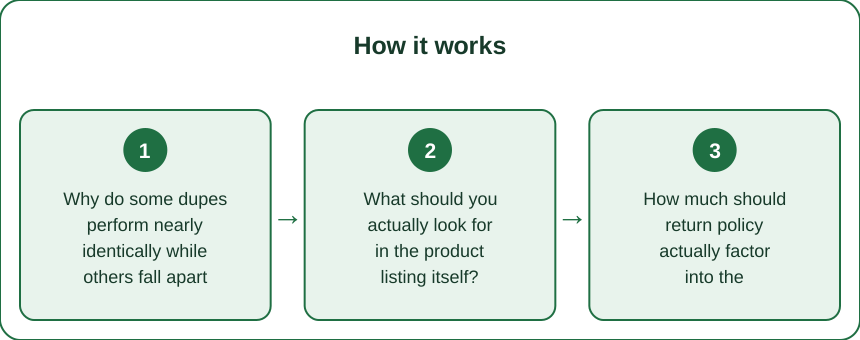
Why do some dupes perform nearly identically while others fall apart fast?
The gap almost always comes down to fabric composition and weight, not branding. A legging with a similar spandex-to-nylon or spandex-to-polyester ratio and similar grams-per-square-meter weight to the original will perform very similarly in stretch recovery and opacity, regardless of price. Dupes that cut costs by using thinner fabric or a cheaper fiber blend are the ones that pill, sag, or turn see-through within weeks.
This is why checking the actual fabric composition percentage in the listing (not just “premium fabric” marketing language) is the single most useful five-second check before buying.
What should you actually look for in the product listing itself?
Beyond fabric composition, look for fabric weight in grams per square meter (gsm) when listed — higher gsm generally means more substantial, less see-through fabric, which matters enormously for leggings and other fitted pieces. Also check for mentions of a flatlock or four-way stretch seam construction, since seam quality is one of the fastest points of failure in lower-quality dupes.
Product photos showing the item stretched or in motion (not just laid flat) give a better sense of how it actually performs than static studio photos alone.
How much should return policy actually factor into the decision?
Quite a lot — a generous, clearly stated return window is one of the strongest signals a seller stands behind their product’s actual quality, since sellers of consistently poor-quality dupes tend to restrict or complicate returns specifically to reduce return volume. A vague or heavily restricted return policy (short windows, “final sale” on all items, no size exchange) is a real red flag worth weighing as heavily as the product photos themselves.
Before buying, it’s worth specifically checking whether the return policy covers fit issues, not just defects — fit is the single most common reason dupe purchases get returned.
What Nobody Tells You About Dupe Shopping
Nobody tells you that the same manufacturer sometimes produces both a name-brand item and its dupe on shared factory lines, which is why some dupes are functionally identical while others from a completely different, lower-quality supply chain aren’t — there’s no way to know this from the listing alone, which is exactly why fabric specifics and reviews matter more than assuming a dupe is automatically lower quality. Nobody mentions that reviews mentioning wash count (“still holds up after 20+ washes”) are far more useful than reviews just describing initial impressions, since first-wear satisfaction doesn’t predict longevity.
Is there a real dollar threshold where a dupe stops making financial sense?
When a dupe is priced within roughly 60-70% of the original’s cost, the actual savings often aren’t worth the increased uncertainty around quality and longevity — at that price gap, the original’s established durability track record can be the better value. Dupes make the clearest financial sense when priced at 30-50% or less of the original, where even a somewhat shorter lifespan still nets out as genuine savings.
How do you evaluate a dupe once it actually arrives, before the return window closes?
Check the seam finish first (flat, even stitching versus loose or puckered seams), then do a stretch test by pulling the fabric to see how quickly and fully it recovers its shape — slow or incomplete recovery is an early sign of poor spandex quality that will worsen with washing. Also do a quick squat or lunge test while wearing it to check for see-through under stretch, which is one of the most common dupe disappointments and one of the easiest to catch immediately.
FAQ: Buying Activewear Dupes Questions, Answered
Do dupe brands ever get meaningfully better over time?
Yes — some dupe-focused brands have improved their fabric sourcing and construction significantly over a few years as they’ve built repeat customer bases, so checking recent reviews specifically (not just overall rating) gives a more accurate current picture.
Is it worth buying one item from a new dupe brand before committing to a full wardrobe swap?
Yes, strongly recommended — a single test purchase, ideally with a flexible return policy, is the lowest-risk way to evaluate a new brand before replacing multiple higher-cost original pieces.
Are dupes ever actually made with better fabric than the original they’re copying?
Occasionally, yes — some dupe brands specifically target a fabric-feel improvement as their differentiator, though this is the exception rather than the norm and is worth verifying through recent, wash-count-specific reviews rather than assuming.
TL;DR:
- Fabric composition and weight (gsm) predict performance far better than price or branding
- Seam construction and return policy quality are strong indicators of overall product quality
- Dupes priced at 30-50% of the original tend to offer the clearest genuine savings
- Test new arrivals with a stretch and movement check before the return window closes
Evaluating dupes on specifics rather than price alone turns dupe shopping from a gamble into a genuinely reliable way to save money.
See It in Motion
Seen here: High Waist Embossed Yoga Leggings with Side Pockets — shop it on bubblelime.com
Keep Reading
This article is for general informational and styling purposes only. Fit, sizing, and product availability may vary.