The Activewear Dupe Tradeoff Nobody Mentions: What Happens When Something Goes Wrong
Quick Answer: Established activewear brands generally offer more reliable customer service, warranty coverage, and return policies than most dupe sellers, many of which operate through marketplaces with limited accountability, minimal quality guarantees, and return windows that are harder to actually use — this gap in post-purchase support is a real cost of buying a dupe that rarely factors into the initial price comparison, even when the product itself performs nearly identically at first wear.
The sticker price comparison between a dupe and the original leaves out an entire category of value — what happens if something goes wrong — that only becomes visible after the purchase.
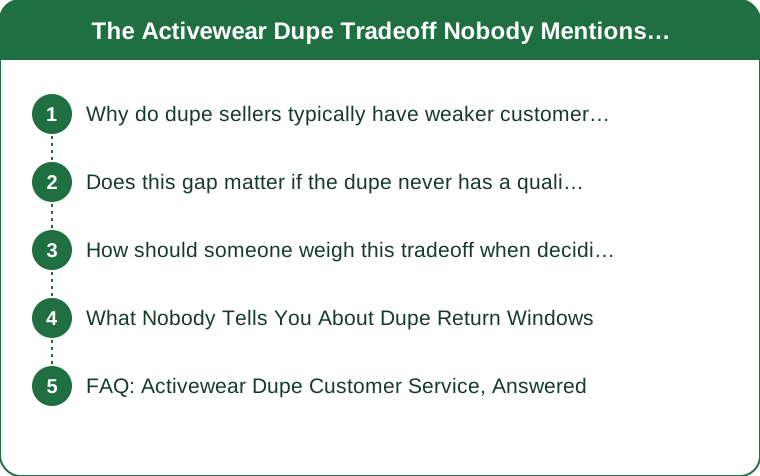
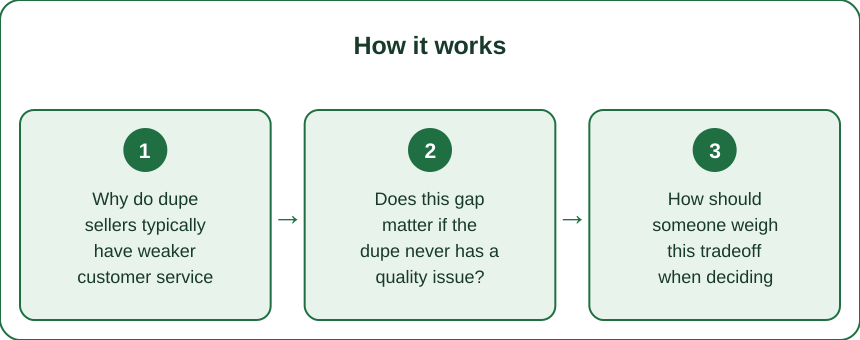
Why do dupe sellers typically have weaker customer service than established brands?
Many dupe products are sold through third-party marketplace listings or smaller direct-to-consumer operations without the established brand’s customer service infrastructure, dedicated size-exchange systems, or quality guarantee programs, which means resolving a problem often takes considerably more effort and has a lower success rate than with an established brand.
Does this gap matter if the dupe never has a quality issue?
For a dupe that performs perfectly with no defects, the customer service gap never becomes relevant in practice, which is part of why many dupe purchases feel like a clear win — but the risk is asymmetric, since a defective dupe often means eating the full cost with no real recourse, unlike an established brand’s defect that’s more likely to be replaced or refunded.

How should someone weigh this tradeoff when deciding whether to buy a dupe?
Considering how essential or expensive the specific piece is, and how much a quality failure would actually cost to replace out of pocket, is a reasonable way to weigh the tradeoff — a low-cost, easily replaceable dupe item carries less downside risk than a higher-cost dupe purchase with a weak return policy.
What Nobody Tells You About Dupe Return Windows
Nobody tells you that many dupe sellers’ stated return windows are technically accurate but practically difficult to use — requiring the buyer to cover return shipping internationally, or requiring photo evidence submitted through a slow support process — which functionally discourages most buyers from actually completing a return even when eligible.
FAQ: Activewear Dupe Customer Service, Answered
Is there a way to check a dupe seller’s return policy reliability before buying?
Checking recent buyer reviews specifically mentioning return or defect experiences, rather than just product quality reviews, gives a more accurate picture of actual post-purchase support.
Do dupe sellers on major marketplaces offer better protection than standalone dupe websites?
Generally yes, since major marketplaces often have their own buyer protection policies that apply regardless of the individual seller’s own return policy, adding a layer of backup protection.
Is it reasonable to pay a bit more for a dupe from a seller with a stronger reputation and return policy?
Yes, for anyone weighing multiple similar dupe options, factoring in seller reputation and return policy quality alongside price is a reasonable part of the decision.
TL;DR:
- Established brands generally offer stronger warranty and customer service support than most dupe sellers
- This gap only matters in practice if something actually goes wrong with the item
- Weighing an item’s cost and how essential it is helps decide how much this risk matters for a given purchase
- Marketplace buyer protections can offer a useful backup layer beyond a dupe seller’s own policy
The real price of a dupe includes this invisible customer-service gap — worth factoring in for higher-cost purchases even when the upfront price comparison looks like an easy win.
Keep Reading
This article is for general informational and styling purposes only. Fit, sizing, and product availability may vary.