The Complete System for Evaluating an Activewear Dupe Before You Buy
Quick Answer: A good dupe evaluation runs six checks in order: fabric composition and weight, construction and seam type, fit and recovery, seller and listing signals, total cost math including replacement rate, and the return policy stress test. Most bad dupe purchases fail at check four or five — the seller and the math — not at the fabric, which is where everyone looks first.
The dupe economy has gotten sophisticated. Some are genuinely excellent value. Some are the same garment with a different label. And some cost you twice because you buy them twice.
This is the full system for telling them apart before the money leaves your account.

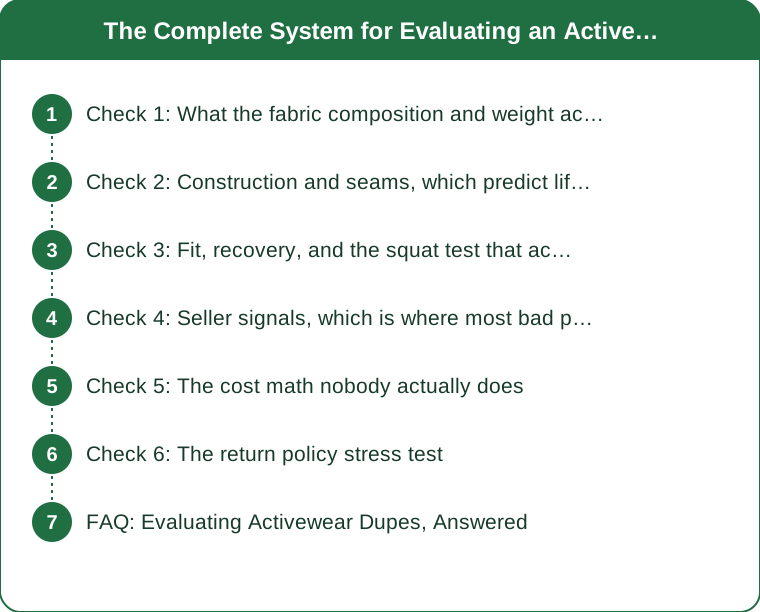
Check 1: What the fabric composition and weight actually tell you
This is where everyone starts, and it is genuinely informative — provided you know what to read.
Composition first. Most performance leggings are a nylon-elastane or polyester-elastane blend. The difference matters more than most listings suggest. Nylon is softer, more durable against abrasion, and more expensive. Polyester is cheaper, dries faster, holds printed color better, and resists odor less well. A nylon-dominant blend is a meaningful quality signal; a polyester blend is not automatically bad but tells you where the cost was saved.
Elastane percentage is the number to check. Roughly 18 to 25 percent elastane is typical for a compressive, high-support legging. Below about 12 percent, you are usually looking at a softer, less supportive garment that will feel comfortable initially and lose shape faster. Above 30 percent, expect very high stretch and, often, faster degradation.
Fabric weight is the specification most dupes omit, and its absence is itself information. Quality activewear is often listed with a GSM figure — grams per square meter. Typical performance leggings run roughly 200 to 300 GSM. Below about 190 GSM you are in sheerness territory regardless of what the listing claims. A brand that publishes GSM is confident about it; a brand that does not usually has a reason.
What to do with a listing that gives you nothing: treat missing composition as a red flag rather than an oversight. Composition labelling is legally required on the garment itself in most markets, so a seller who cannot put it in a listing either does not know what they are selling or does not want you to.
The comparison move: find the original’s published composition and weight, then compare. A dupe at 87 percent polyester against an original at 79 percent nylon is not the same garment at a lower price. It is a different garment that looks similar in photographs.
What composition does not tell you: yarn quality, knit construction, and finishing all vary enormously within the same composition. Two garments listed as 78 percent nylon and 22 percent elastane can perform completely differently. Composition rules things out; it cannot rule things in.
Check 2: Construction and seams, which predict lifespan better than fabric
Fabric determines how a garment feels on day one. Construction determines whether it survives to day one hundred, and it is the check most shoppers skip entirely.
Seam type is the highest-signal detail. Look for flatlock seams — flat, wide, with visible parallel stitching — which lie flat against skin, do not chafe, and distribute stress well. Overlock seams, which are the narrow rolled edge you see on cheap garments, are faster and cheaper to produce and are more prone to chafing and to failing at stress points. Some premium garments use bonded or laser-cut seams, which eliminate stitching entirely at some cost in durability under heavy stress.
Where to look specifically: the crotch gusset. A diamond or triangular gusset panel distributes stress across multiple seams and dramatically reduces the chance of a seam blowout in a deep squat. A garment with four seams meeting at a single point in the crotch has one failure point, and it will find it.
Stitch density matters and is easy to check. Count stitches over an inch of seam. Denser stitching holds better under stretch. Sparse, widely spaced stitching on a high-stretch garment is a predictor of failure, not a stylistic choice.
Waistband construction is the second big one. Look for a waistband with multiple layers or an internal elastic band, not a single folded layer of the shell fabric. Single-layer waistbands roll, lose shape, and are the most common source of “they fit fine but they keep sliding down” complaints.
Check the thread color and quality at stress points. Contrast or poorly matched thread, loose ends, and visible skipped stitches all indicate low quality control. If a garment shipped with visible defects, the quality control tolerance is wide, which tells you what the average unit looks like.
What you can assess from photographs: seam type is usually visible in close-up product shots, and gusset presence is visible in flat-lay images. If neither is shown in any photograph across the entire listing, that is worth noticing. Sellers photograph what flatters.
Check 3: Fit, recovery, and the squat test that actually matters
This check happens after purchase, which is why check six — return policy — is inseparable from it.
Recovery is the property that separates good activewear from bad, and it is almost never mentioned in listings. Recovery is the fabric’s ability to return to its original shape after being stretched. Poor recovery is why leggings bag at the knees after twenty minutes, why the waistband stops holding, and why a garment that fit perfectly in the fitting room is loose by the end of a workout.
How to test recovery at home: stretch a section of fabric firmly for about ten seconds, release, and watch. Good recovery snaps back immediately with no visible deformation. Poor recovery leaves the fabric visibly slack for a few seconds or permanently. Do this on the thigh panel and again on the waistband — they are often different fabrics.
The squat test, done properly: put them on, stand in front of a mirror in the brightest light you have, and do a deep squat. Have someone photograph you from behind, or use a phone timer. You are checking three things: whether the fabric goes sheer under stretch, whether the waistband rolls or slides, and whether any seam pulls visibly at the crotch or the back rise.
Do not do this test in dim bedroom light. Sheerness is a light-dependent property, and the gym has bright overhead lighting that a bedroom does not. Natural daylight near a window is the honest test.
The wear test that predicts the most: wear them for a full session, not five minutes. Chafing, waistband migration, and seam irritation all take twenty minutes to show up. Many people discover a garment’s actual flaw on the second wear, well past the return window they did not check.
Fit variation between dupes and originals is real and asymmetric. Dupes are often produced to a different size grading, so a size that fits in the original may not fit in the dupe. Between-size shoppers should assume they will need to exchange, which makes the return policy the deciding factor rather than a technicality.

Check 4: Seller signals, which is where most bad purchases actually originate
This is the check that separates a savvy dupe buyer from someone who is about to have a bad time, and it has nothing to do with the garment.
Red flags in the listing itself:
- Stock photography that is clearly the original brand’s imagery. If the photos show a garment with visible branding that is not the seller’s, you are looking at a listing that does not depict what will arrive.
- No photograph of the actual garment’s tags or label, which is standard practice for legitimate sellers and absent from most problematic ones.
- A price that is a small fraction of the original. A 40 to 60 percent discount is plausible for a legitimate lower-cost manufacturer. A 90 percent discount on a technical garment usually means the fabric is not what is described.
- Aggressive countdown timers, “only 3 left,” and rotating flash discounts. These are conversion tactics, and their heavy presence correlates with sellers who do not expect repeat customers.
- Reviews that are overwhelmingly five-star, short, and generic, or that reference a completely different product category.
What to check outside the listing:
- How long the domain or storefront has existed. Very new stores with very broad catalogs are typically dropshipping operations with no relationship to the manufacturer.
- Whether a physical address and a real customer service contact exist. A contact form and nothing else is a signal about what happens when you need a return.
- Whether the same product photographs appear across a dozen unrelated store names. They frequently do, and it tells you the store is a storefront, not a brand.
Social media advertising deserves specific caution. A large share of problematic activewear sellers reach customers primarily through paid social ads, where the ad creative is often the original brand’s own marketing footage. If you found the product in an ad and cannot find the brand any other way, that is meaningful.
The single best seller signal: a clear, specific, published return policy with a stated address for returns. Everything else can be faked cheaply. A functioning returns operation cannot.
Check 5: The cost math nobody actually does
This is where the dupe argument is won or lost, and almost nobody runs the numbers.
The comparison people make: $30 dupe versus $98 original. Obvious.
The comparison that matters: cost per wear over the garment’s actual lifespan.
Work it through. Suppose the original lasts 200 wears before it is genuinely done — pilled, sagging, or sheer. At $98, that is $0.49 per wear.
Suppose the dupe lasts 60 wears. At $30, that is $0.50 per wear — identical. The dupe saved you nothing, and you spent the difference in shopping time and in wearing a worse garment for the last twenty wears as it degraded.
Now suppose the dupe lasts 120 wears. At $30, that is $0.25 per wear — genuinely half the cost. That is a real win.
The variable that decides it is lifespan, and lifespan is what you cannot see before buying. This is why checks 1 through 3 matter: composition, construction, and recovery are the observable proxies for the number you actually care about.
The scenario that costs the most is buying the wrong dupe twice. $30 plus $30 plus a return shipping fee plus the original you eventually buy anyway. This is a common path, and it ends at a higher total than buying the original first.
Where dupes genuinely win:
- Trend items you will wear for one season. Lifespan is irrelevant if you will be done with it before it degrades.
- Trying a silhouette or a length you are unsure about, before committing at full price.
- Categories where technical performance barely matters — a walking legging, a lounge set, a layering piece.
- When the dupe is from a legitimate lower-cost brand with its own design and manufacturing, rather than a copy sold by a storefront.
Where they usually lose:
- High-stress use — heavy lifting, running, hot yoga — where seam and recovery quality are load-bearing.
- Items you will wear several times a week for years.
- Anything where sheerness under stretch would be a genuine problem for you.
Check 6: The return policy stress test
The final check, and the one that makes every earlier check survivable if you get one wrong.
Read the actual policy, not the badge. “Free returns” in a banner and a policy page that specifies the customer pays international return shipping to an address abroad are not the same thing, and both appear on the same site regularly.
The specific questions to answer before you buy:
- Who pays return shipping? For an international seller, return shipping can exceed the value of the garment, which functionally means there are no returns.
- What is the window, and does it start at purchase or delivery? A 14-day window starting at purchase with a 12-day shipping time is a two-day window.
- Is there a restocking fee?
- Are worn items returnable? Many activewear returns require unworn condition with tags, which conflicts directly with the wear test that reveals the actual problems.
- Where do returns physically go? A domestic return address is a completely different proposition from an address overseas.
- Is store credit the only remedy? Store credit at a store you now distrust has limited value.
The stress test: imagine the garment arrives, fits badly, and you want your money back. Walk through exactly what you would have to do. If that sequence involves paying international shipping, chasing an email address for a return authorization, or a 14-day window that has already closed, the effective price of the dupe is the full price with no recourse.
Price that risk in. A $30 dupe with no functional returns should be evaluated as a $30 gamble, not a $30 purchase. Sometimes that is a fine bet. It is a different bet from the one most people think they are making.
The practical rule that follows: for anything above about $25, or anything you need to fit correctly, buy only from sellers with a domestic return address and a stated window that starts at delivery. That single filter eliminates the large majority of bad outcomes in this category.
FAQ: Evaluating Activewear Dupes, Answered
Are dupes ever actually as good as the original?
Sometimes, particularly from legitimate lower-cost brands with their own manufacturing. The composition, weight, and construction checks will tell you when you are looking at one of those, and it is genuinely worth the search.
What is the single most predictive check?
Construction — specifically seam type and gusset design. Fabric feel varies by taste; seams predict whether the garment is still wearable in a year.
How do I check GSM if the listing does not state it?
You cannot, before buying. Treat the absence as a signal, and use price, composition, and photographs of the fabric held up to light as proxies. After it arrives, a very light garment that is visibly translucent when stretched is under 190 GSM regardless of claims.
Is it worth buying a dupe of something I have never tried?
Only with a functioning return policy. Fit grading differs between dupes and originals, so the odds of needing an exchange are meaningfully higher than for a brand you know.
How many wears should good activewear actually last?
With reasonable care, a well-made pair of leggings should stay in good condition for a couple of hundred wears. Cold wash, no fabric softener, and line drying extend it considerably — poor laundry habits shorten the life of any garment far faster than the brand does.
TL;DR: Run six checks, in order, and most bad dupe purchases become avoidable.
- Fabric: nylon-dominant beats polyester-dominant; 18 to 25 percent elastane for support; under 190 GSM means sheer. Missing composition is a red flag.
- Construction: flatlock seams over overlock, a diamond gusset over a four-seam junction, a multi-layer waistband over a single fold. This predicts lifespan better than fabric.
- Fit and recovery: stretch-and-release test on thigh and waistband, squat test in bright daylight, full-session wear test.
- Seller signals: original-brand stock photos, 90 percent discounts, countdown timers, and no return address are the warning set.
- Cost math: compare cost per wear, not price. A $30 dupe lasting 60 wears saves nothing against a $98 original lasting 200.
- Return policy stress test: if returning it means international shipping or a window that already closed, you are making a gamble, not a purchase.
Start with check six. If returns do not work, none of the other five can save you.
See It in Motion
Seen here: High Waist Yoga Leggings with Side Pockets — shop it on bubblelime.com
Keep Reading
This article is for general informational and styling purposes only. Fit, sizing, and product availability may vary.