The Real Psychology Behind Why Dupe Shopping Feels So Satisfying — and Where It Can Go Wrong
Quick Answer: Dupe shopping satisfies a specific psychological reward — feeling smart, not just saving money — which is genuinely useful when it drives better comparison shopping, but can backfire when the hunt for the next dupe becomes its own spending habit. Track total annual spend, not just per-item savings, to know which side of that line you’re on.
You didn’t just save $40 on that legging dupe — you felt clever doing it, which is a completely different kind of satisfying than a regular discount ever gives you. That feeling is real, useful, and worth understanding, because it’s also exactly what can quietly turn a smart habit into a spending trap.

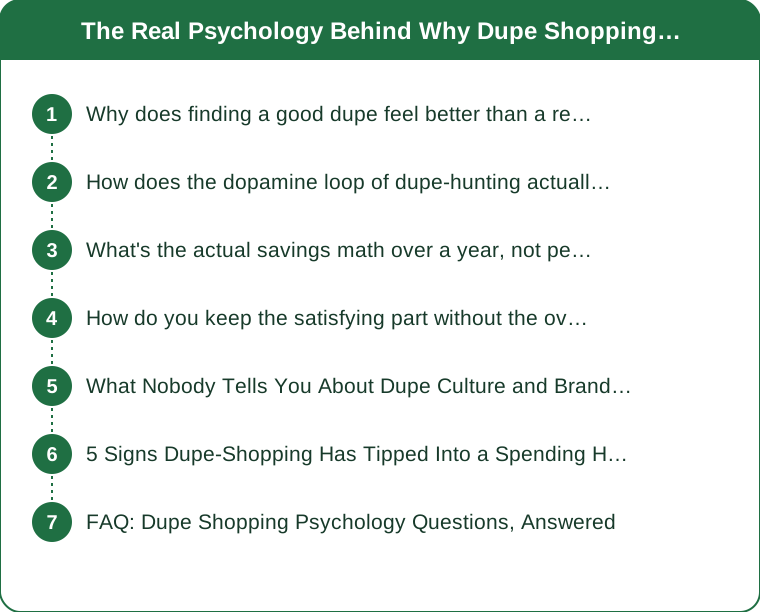
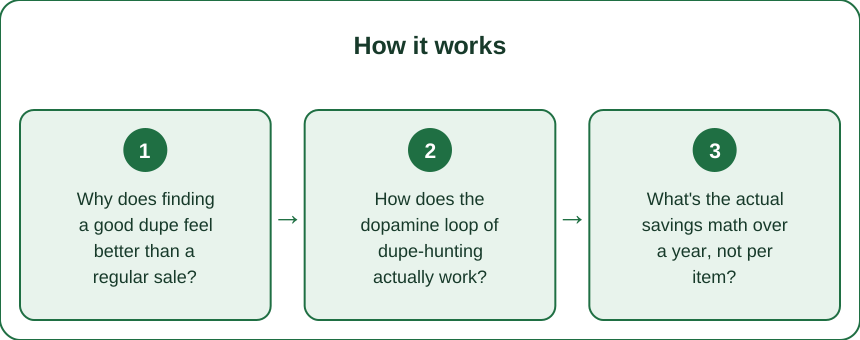
Why does finding a good dupe feel better than a regular sale?
A discount on the original brand makes you feel lucky; finding a dupe that performs nearly as well makes you feel smart — you cracked a code the brand’s markup was hiding. That’s a self-esteem reward, not just a financial one, and it’s a stronger, stickier form of satisfaction than a simple percent-off ever produces.
This is backed by well-documented consumer psychology around “savvy shopper” identity — people who successfully dupe-shop report feeling more competent and in-control of their spending than people who just wait for sales, even when the dollar savings are similar. The difference isn’t the money. It’s the sense of having outsmarted a system that was designed to make you pay more for a logo.
That identity boost is also why dupe finds get shared so eagerly. Posting “found the dupe” isn’t just helpful content — it’s a public display of the exact competence the purchase made you feel, which reinforces the behavior even further the next time you’re deciding whether to buy the original or go looking.
How does the dopamine loop of dupe-hunting actually work?
Finding a great dupe activates a variable reward pattern similar to a treasure hunt — you don’t know in advance if a given dupe will be good, so successful finds feel disproportionately rewarding compared to predictable purchases. This is the same reward structure behind a lot of compulsive shopping behavior, just applied to comparison shopping instead of straightforward buying.
The risk isn’t the first dupe purchase — it’s that the searching itself becomes rewarding independent of whether you need anything new, which is how a genuinely money-saving habit starts generating unplanned purchases. Scrolling dupe-comparison content for twenty minutes can feel productive and thrifty even when nothing gets bought, because the anticipation itself is doing the same reward-system work that the eventual purchase does.
This matters because it means the habit can feel virtuous right up until the moment it isn’t. Someone who has never overspent on full-price shopping can still develop a genuine overspending pattern through dupes specifically, because the low price of each individual item makes the accumulating frequency easy to miss.
What’s the actual savings math over a year, not per item?
A single $70-versus-$25 legging dupe looks like a clear $45 win. But dupe-shopping frequently increases total purchase frequency — people who dupe-shop report buying activewear more often than people who buy fewer, pricier originals, because the lower per-item cost lowers the psychological barrier to each purchase.
Track your total annual activewear spend for two months before and after adopting dupe-shopping. If the total is lower, the habit is working as intended. If it’s flat or higher despite lower per-item prices, the frequency increase has quietly erased the savings — and this is the calculation almost nobody actually runs, because each individual purchase still feels like a win in isolation.
A useful gut-check: write down every activewear purchase for a month, dupe or not, with price and date, no judgment. Most people are surprised by the total once it’s added up in one place rather than experienced as a series of small, separately-justified decisions.

How do you keep the satisfying part without the overspending part?
Set a pre-decided category budget (say, $150/season for activewear) before you start browsing dupes, and treat every dupe purchase as coming out of that fixed pool rather than being “free” because it’s cheap. This preserves the smart-shopper satisfaction while capping total frequency, since the reward now comes from staying inside a budget skillfully rather than from unlimited comparison shopping.
Also separate need-based dupe shopping (replacing a worn-out piece) from hunt-based browsing (scrolling for the next find with nothing specific needed) — the second is where most unplanned spend originates, and naming it honestly is often enough to reduce it. A simple rule that works for a lot of people: only browse dupe content when there’s an actual gap in the wardrobe, not as a standalone activity during downtime.
A cooling-off window helps too — a 24-hour wait between finding a dupe and buying it filters out a meaningful share of hunt-driven purchases, since the appeal of many finds fades once the immediate excitement of discovery passes.
What Nobody Tells You About Dupe Culture and Brand Loyalty
Ironically, successful dupe-hunters often end up more loyal to the idea of the original brand than non-dupe-shoppers — the dupe search validates that the original brand’s quality or design is worth chasing a copy of in the first place, which is part of why brands rarely fight dupe culture as hard as you’d expect.
Some brands have quietly started tracking dupe-driven interest as free marketing, since a viral “dupe alert” post frequently drives search traffic and eventual purchases toward the original brand too, once a shopper’s budget allows it. In effect, the dupe search functions as an extended trial period — you get to confirm the design and fit are worth wanting before ever paying full price, and some portion of dupe-shoppers do eventually convert to the original once income or priorities shift.
This is worth knowing because it reframes dupe shopping as something other than pure rebellion against markup — for a lot of shoppers it’s closer to a multi-year path toward the original, mediated by budget, not a permanent rejection of it.
5 Signs Dupe-Shopping Has Tipped Into a Spending Habit
1. You’re browsing dupe content with no specific item in mind. That’s hunt-mode, not need-based shopping, and it’s the single strongest predictor of unplanned spend.
2. Your total activewear spend hasn’t dropped despite cheaper per-item prices. The math isn’t working the way it should, and per-item savings are being erased by frequency.
3. You feel a letdown after a few days without finding a new dupe. That’s the reward-loop talking, not a genuine gap in your wardrobe — treat it as a signal to pause, not to search harder.
4. You own multiple dupes of very similar items. Redundant purchases are a clear frequency-inflation signal that the hunt itself, not the need, is driving the cart.
5. You justify a purchase primarily by how cheap it is relative to the original, not by whether you need it. Price-anchoring to the original is a psychological trick worth noticing — a $25 item is not automatically a good buy just because the original costs $70.
FAQ: Dupe Shopping Psychology Questions, Answered
Is dupe shopping inherently a bad habit?
No — for most people it’s a genuinely smart way to comparison-shop, as long as total spend and purchase frequency are tracked, not just per-item price. The habit becomes a problem specifically when the searching itself, not the need, is what’s driving purchases.
Why do I feel guilty even when a dupe is a great deal?
Often it’s not guilt about the price — it’s an intuitive sense that the purchase was hunt-driven rather than need-driven, which is worth listening to rather than dismissing as irrational.
Does setting a budget really change the psychological reward?
Yes — people report the same “smart shopper” satisfaction from a good find within a pre-set budget, since the reward comes from the comparison itself, not from unlimited access to more finds. A budget doesn’t remove the fun of the hunt; it just gives the hunt a finish line.
TL;DR:
- Dupe satisfaction is a smart-shopper reward, not just a financial one — that’s real and useful
- The searching itself can become rewarding independent of need, which is where overspending sneaks in
- Track total annual spend, not per-item savings, to see if the habit is actually saving money
- Separate need-based dupe shopping from hunt-based browsing — the second drives most overspending
- A pre-set category budget and a 24-hour cooling-off window preserve the satisfaction while capping frequency creep
See It in Motion
Seen here: Super High Waist Embossed Yoga Leggings with Inner Pocket — shop it on bubblelime.com
Keep Reading
This article is for general informational and styling purposes only. Fit, sizing, and product availability may vary.